
Leats
Fresh meat and seafood delivered on an own fleet, on a platform that knows a whole fish is not the thing it sells. Storefront, warehouse, processing, delivery and finance in one system.
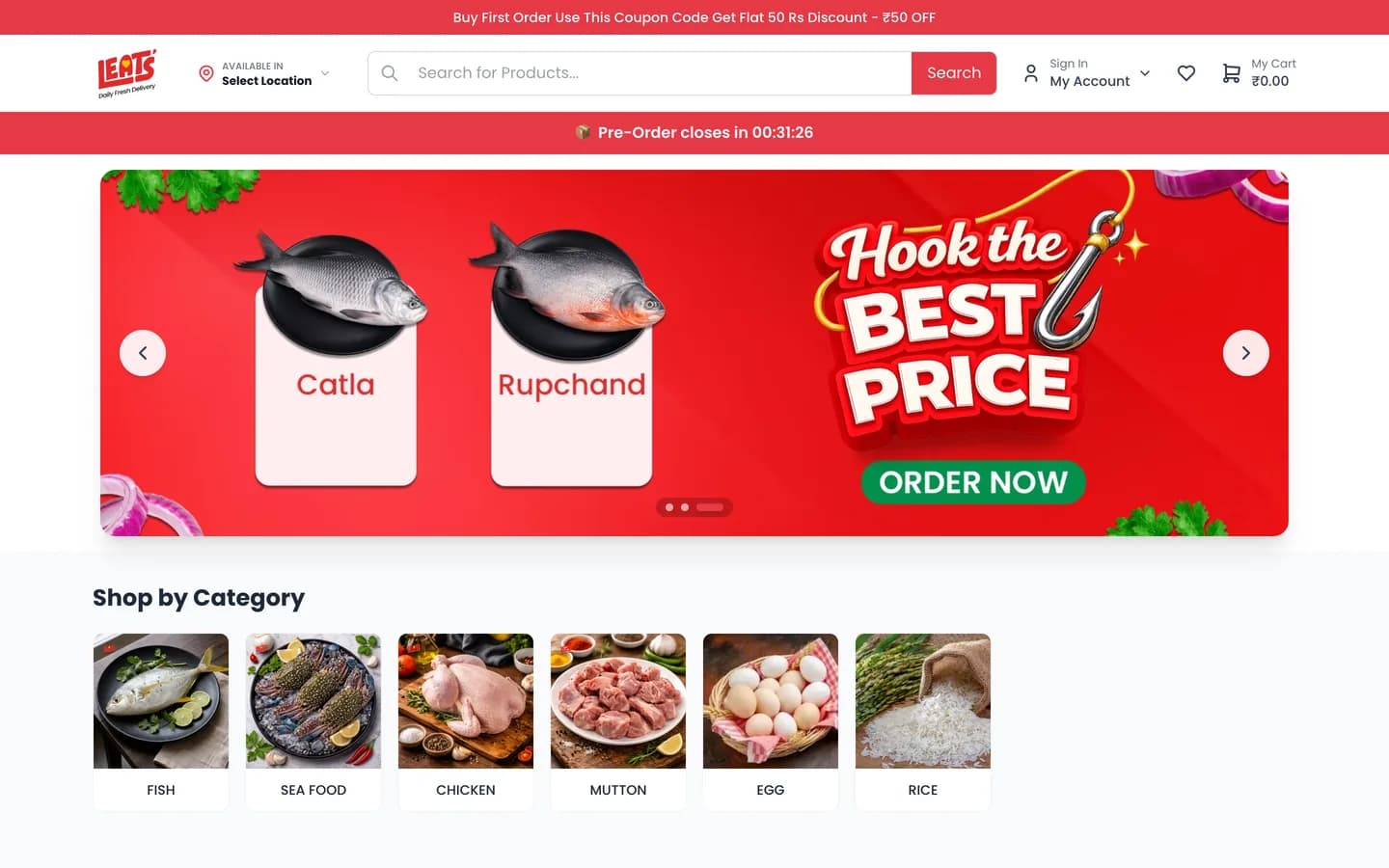
Leats Food Corporation sells fresh fish, seafood, chicken and mutton and delivers it with its own riders. MnT Future built the platform end to end: the storefront, a warehouse and inventory system, the processing model that turns raw material into sellable cuts, a delivery-partner app with zones and live tracking, plus procurement, finance and POS. The hard part is not the shop. It is that Leats buys a whole fish by weight and sells eleven different cuts of it, so inventory has to be transformed rather than counted, with cost and wastage carried through. Any US business that buys raw and sells processed, from a butcher D2C brand to a meal-kit company, has the same problem.
A whole fish is not a product
Most commerce platforms assume the thing you buy is the thing you sell. Fresh food breaks that assumption on day one. Leats buys a whole fish, or a whole goat, by weight and at a price that moves week to week, then cuts it into named products a customer actually orders: fillets, curry cut, biryani cut. Some of the raw material becomes waste. If the system only counts finished products, nobody can answer what a kilo of raw material actually yielded, what the cuts really cost, or whether a supplier's price was worth paying. On top of that, perishables are delivered by Leats' own riders rather than a courier, so the platform also had to know which pincodes are serviceable, what delivery costs there, where the rider is, and who is working today.
A senior-led path from idea to live.
Make raw material its own kind of stock
Raw material lives in a processing pool measured by weight, carrying a weighted-average purchase price and a total value. It is inventory, but it is not a product anyone can order.
Model the cut as a transaction, not a guess
Processing a batch records what went in, what it cost, every finished item that came out, and the wastage. Recipes accumulate from real runs, so the platform learns what a given input typically yields instead of being told.
Build the fleet into the platform
Delivery partners get their own authenticated app with assigned deliveries, push notifications and reports. Zones are defined down to the pincode with their own charges, and tracking updates ride a websocket rather than a refresh button.
Put operations and money in the same system
Warehouses, stock adjustments, suppliers, purchase orders, bills, expenses, GST invoicing, employees and roles all live alongside the storefront, so the numbers the business runs on come from the same data the shop does.
What we built
For customers
- Catalogue of fish, seafood, chicken, mutton, eggs and rice, ordered by cut and by weight
- Serviceability resolved by pincode before checkout, with delivery charges set per zone
- Scheduled delivery windows rather than an open-ended promise
- Coupons with usage tracking, wishlist and cart
- Razorpay checkout, and live order tracking as the rider moves
- Bulk-order and catering enquiries routed as their own workflow
For the operations team
- Processing pools holding raw material by weight at weighted-average cost
- Processing runs that record inputs, outputs, wastage and cost per batch
- Warehouse inventory with stock adjustments and an audit trail
- Suppliers, purchase orders, bills and expense categories in the same back office
- GST rates, invoice settings and an invoice sequence that does not skip
- POS for counter sales, on the same catalogue and stock
- Departments, roles, employees and working hours
- Dashboard and exports over sales, delivery and finance
For delivery partners
- Separate authenticated app for riders, with their own assigned deliveries
- Push notifications through Firebase when work is assigned
- Delivery status and tracking written back in real time over websockets
- Per-partner reports for settlement and performance
What we shipped, on screen.
The storefront
Fresh categories, ordered the way the customer thinks about them: by fish, by cut, by weight.
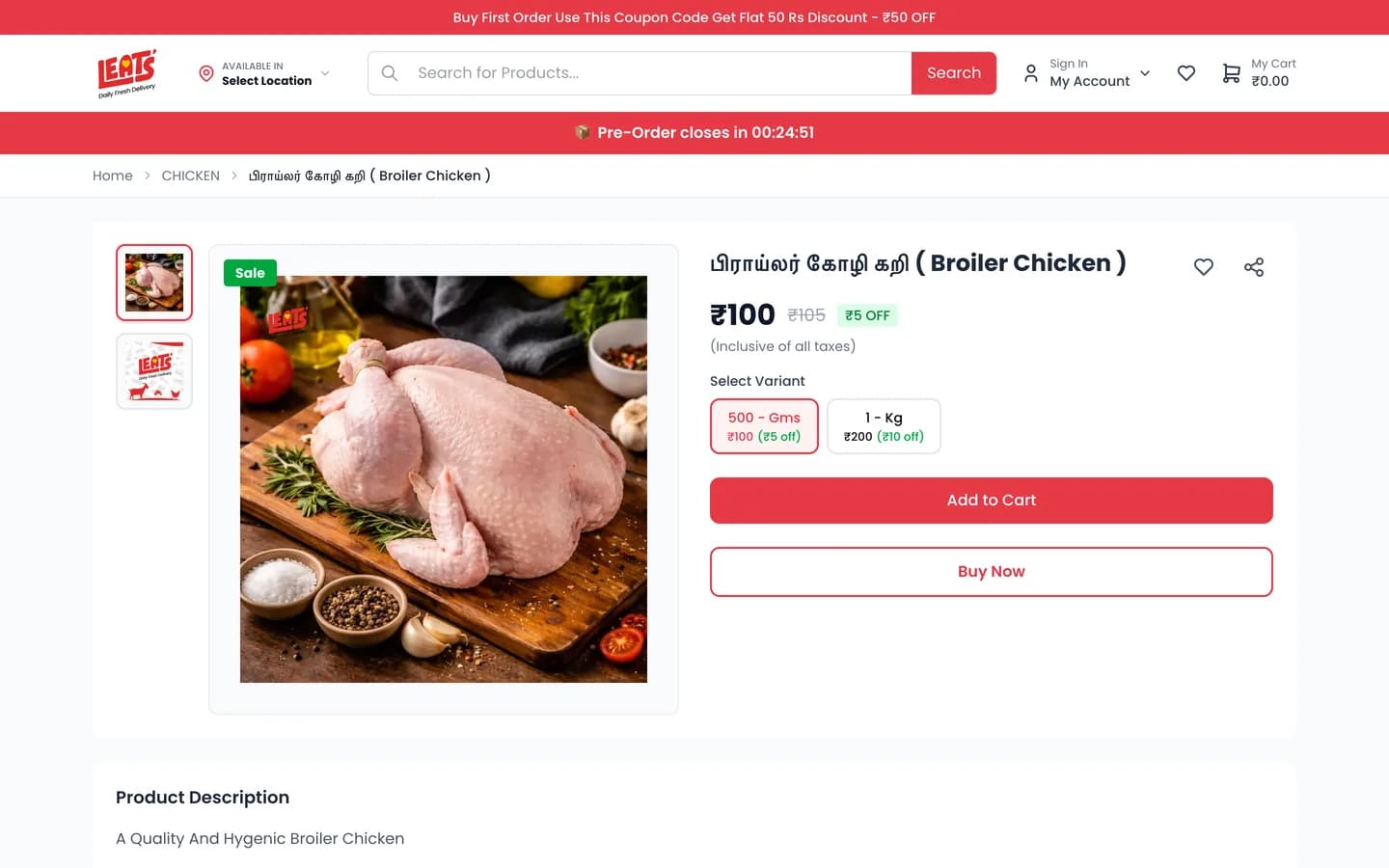
Cut and weight
What a customer picks here is a finished product. Behind it, the platform knows which raw pool it came out of and what it cost.
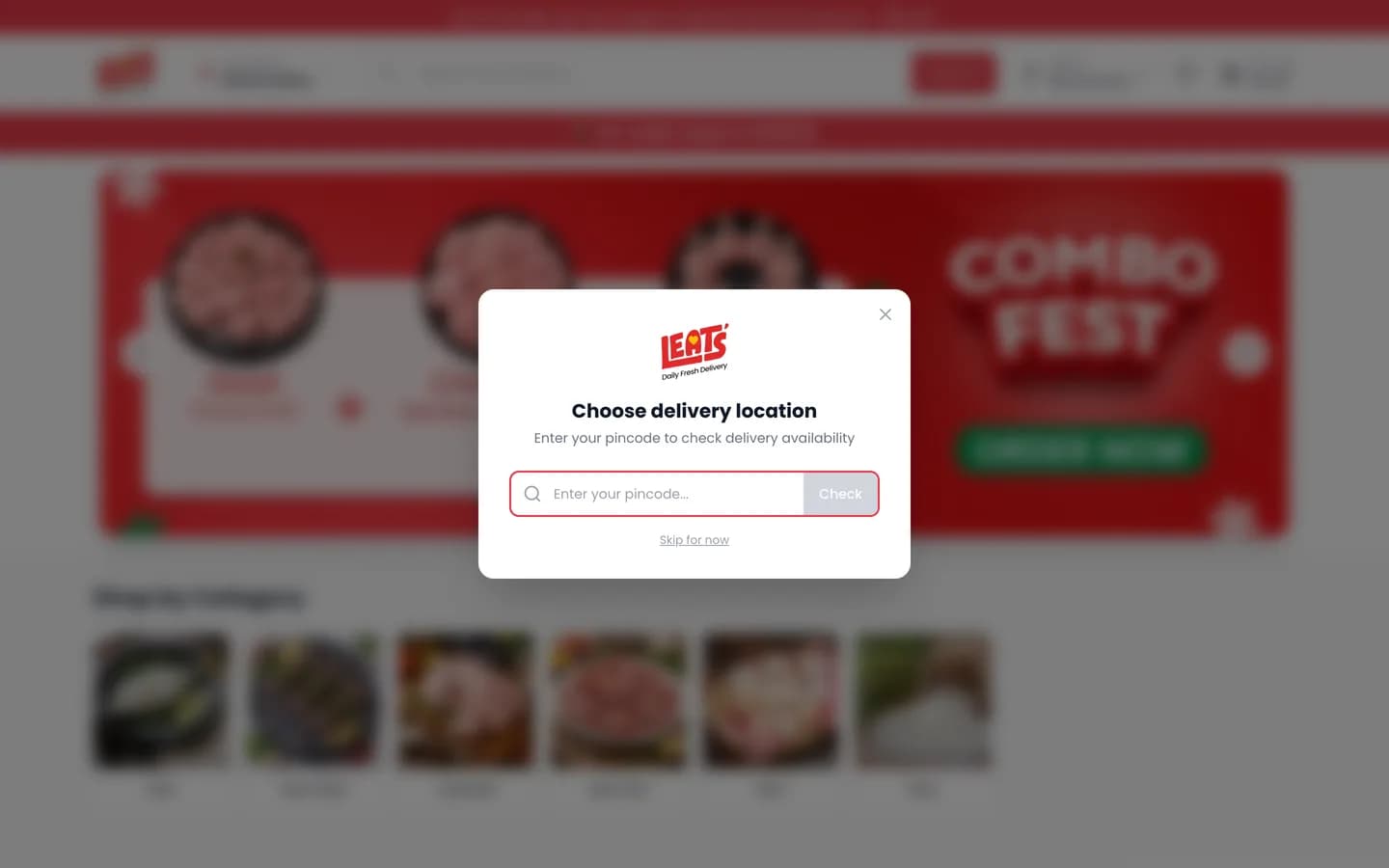
Serviceability before anything else
A pincode decides whether Leats delivers to an address at all. The zone it resolves is what the delivery charge and the slots offered at checkout are read from.
Where the hard problems were.
The decisions that let a fresh-food business price a cut honestly and deliver it on its own fleet.
Inventory that transforms
A whole fish enters as weight and leaves as named products. The platform records the run rather than inferring it, so yield is a number the business owns.
Cost and wastage carried through
Every processing run captures input cost and wastage, so the margin on a cut reflects what the raw material actually cost, not what someone assumed.
The fleet is part of the product
Riders have their own app, zones are defined to the pincode, and the customer's tracking updates over a socket as the delivery moves.
One system, not five
Storefront, warehouse, processing, delivery, POS, procurement, finance and workforce share a single data model of 61 entities.
Engineering decisions
Every technology earned its place by solving a specific problem better than the alternatives.
Processing pool with weighted-average cost
Used for: Raw material is held by weight with a running average purchase price and total value.
Advantage: Purchase prices move constantly in fresh food. A weighted average is the only costing that survives that without re-pricing history every week.
Processing transactions with recorded wastage
Used for: Each run stores input quantity and cost, the output items produced, and the wastage percentage and quantity.
Advantage: Yield becomes measured rather than assumed. It is also the only way to tell a bad supplier from a bad week.
Recipes accumulated from real runs
Used for: An input-to-output pairing per pool, carrying how many times it has been produced and the total quantity.
Advantage: The system learns the operation's actual patterns instead of asking someone to maintain a bill of materials by hand.
Pincode-level delivery zones with their own charges
Used for: Zones carry an explicit pincode list, and charges attach to the zone.
Advantage: Serviceability is answered before the customer has invested in a checkout, and pricing changes are configuration rather than a deploy.
Socket.io for delivery state
Used for: Delivery and tracking updates are pushed to the customer and the operations screen.
Advantage: For perishables the customer's real question is when, not whether. Polling answers it late and costs support calls.
Prisma over MongoDB
Used for: A single typed schema of 61 models across storefront, operations and finance.
Advantage: A domain this wide drifts fast without one schema to check against. The types are the contract between eight subsystems.
What it's built on.
- Node.js
- Express 5
- Prisma
- MongoDB
- Socket.io
- Firebase Cloud Messaging
- Razorpay
- AWS S3
- PDFKit
- Puppeteer
- node-cron
- XLSX
The questions buyers ask about this build.
No. Leats sells its own stock and delivers with its own riders, which is the quick-commerce model rather than the marketplace model. There are no third-party sellers on the platform. Our two-sided marketplace work is LOBBI.
Leats buys a whole fish or a whole goat by weight. Customers buy fillets or curry cut. The platform holds the raw material in a pool priced at a weighted average, then records each processing run: what went in, what came out, and how much was wasted. That is how the business knows what a cut really costs.
The transformation and the fleet. Any US operation that buys raw and sells processed has the same inventory problem, whether that is a butcher D2C brand, a seafood subscription or a meal-kit company. Own-fleet dispatch with zones, slots and live tracking transfers as-is. The India-specific parts are GST invoicing and Razorpay, which a US build replaces with a sales-tax engine and Stripe.
Yes. Architecture, the Express and Prisma backend, the storefront, the admin, the delivery-partner app and the integrations. Published here with Leats Food Corporation's permission.
Selling something you have to make first?
If your stock is transformed, portioned or assembled before it ships, off-the-shelf commerce will fight you. Bring it to a free strategy session and we will map what it actually takes.