
Why AI-Built Stores Crash Under Real Traffic
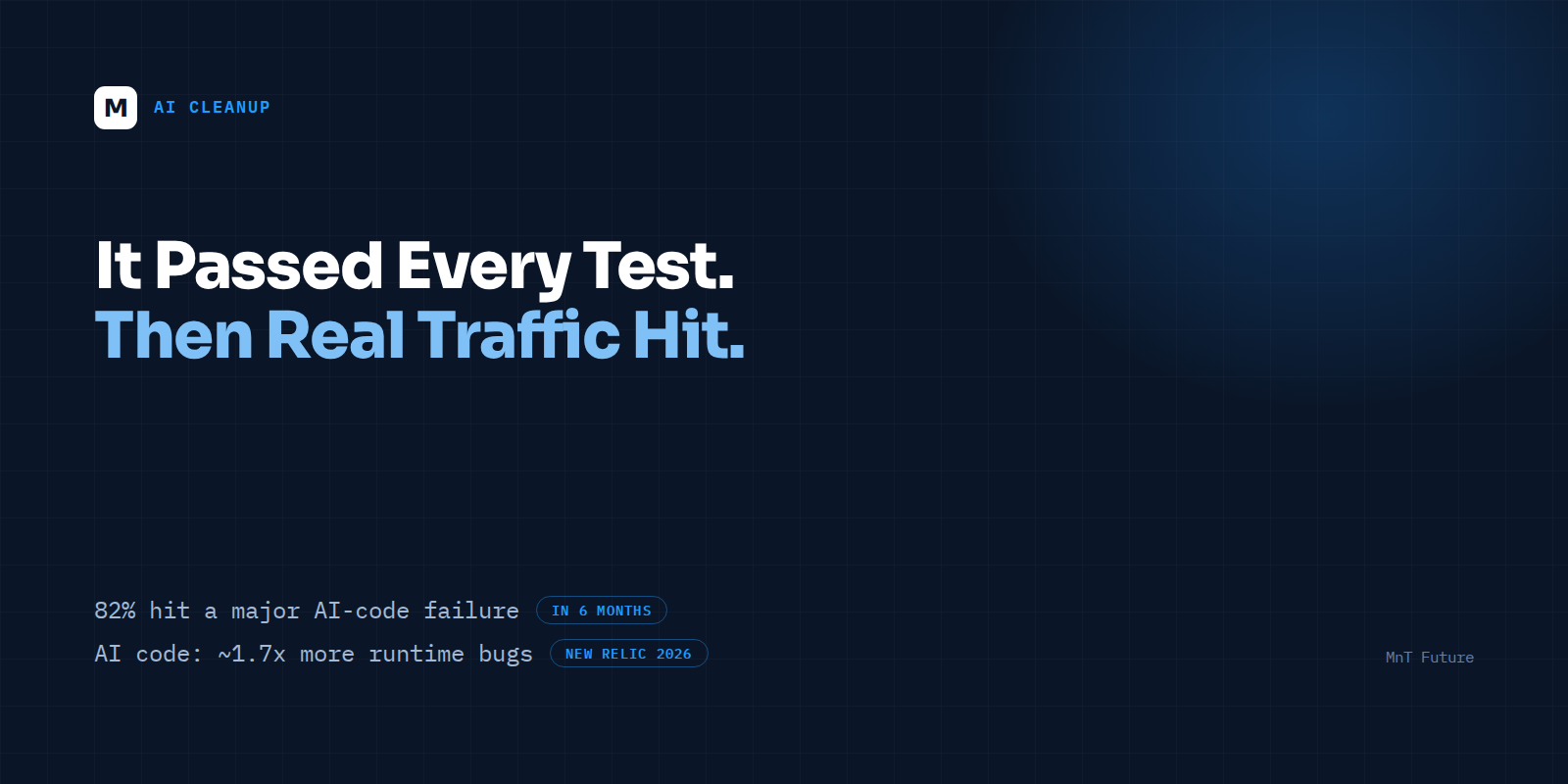
Your store worked in every demo. QA signed off. Then the email went out, or the TikTok post hit, or a sale started — and the site that ran perfectly for a five-person team testing it for three weeks fell over in the first ten minutes of real traffic.
If you built that store with an AI coding tool — Lovable, v0, Bolt.new, Replit, Cursor, or a similar assistant doing most of the heavy lifting — this is not bad luck. It is close to the default outcome, and there is now hard data behind why.
The Store That Passed Every Test and Failed the First Real One
AI coding tools are very good at producing a storefront that works. They are not, by default, producing one that works at scale. The code that renders your product grid, processes a cart update, or writes an order to the database is usually correct for one user clicking through it slowly. It is often catastrophically wrong for five hundred users doing the same thing in the same sixty seconds.
New Relic's 2026 State of AI Coding Report — a survey of 200 US technology decision-makers fielded by Hanover Research and published June 10, 2026 — found that 82% of engineering leaders have experienced at least one major production failure caused by AI-generated code in just the past six months, and that AI-generated code carries roughly 1.7 times more critical runtime issues than code that went through normal human peer review. That gap does not show up in a demo. It shows up the first time real load hits the system.
What "Fine in Testing, Broken in Production" Actually Means
Three patterns account for most of it, and none of them are exotic:
N+1 queries. An AI assistant asked to "show the customer their order history" will often generate one database query to fetch the orders, then a separate query per order to fetch its line items. With five test orders, that is six total queries and nobody notices. With fifty thousand real orders across a Black Friday weekend, that is fifty thousand-plus queries fighting for the same connection pool — and the page that loaded instantly in QA now times out.
No caching layer. Product pages, category listings, and search results get hit by every visitor, every time, with no memory of the last identical request. A human backend engineer adds a cache almost reflexively. An AI assistant optimizing for "does the feature work" usually does not, because a cache is invisible until traffic makes it necessary.
Connection pool exhaustion. Most AI-generated backends assume a handful of concurrent connections to the database. Real traffic — especially a coordinated spike from an email send or an ad campaign — can open hundreds of simultaneous connections in seconds. Architecture that was never built with a connection pool ceiling in mind does not degrade gracefully. It stops responding.
Why This Keeps Happening
It is not that the AI tools are bad. It is that they are optimizing for a different objective than the one a growing store actually needs. An assistant generating code from a prompt is rewarded, implicitly, for producing something that runs and passes the obvious test case. Nothing in that loop asks "what happens at one thousand concurrent users," because nobody tested with one thousand concurrent users — that step got skipped along with the rest of the traditional QA and load-testing phase that a slower, more expensive build would have included by default.
This is also why the failure is so easy to miss until it is expensive. A security hole can sit undetected for months. A performance ceiling only reveals itself the day you succeed at getting traffic — which means the bug you shipped for free becomes visible on exactly the day it costs you the most: a launch, a sale, a feature in the press.
What an Actual Load-Test Audit Looks Like
Finding this before your customers do is a specific, bounded piece of engineering work, not a rebuild. It starts with instrumenting the real database queries the storefront issues under a simulated load — usually a mix of browsing, cart, and checkout traffic scaled up in stages — and watching exactly where response times fall apart: which endpoint, which query, which connection ceiling. From there the fix is almost always targeted: batch the N+1 queries, add a caching layer at the right point in the request path, size and monitor the connection pool, and re-run the same load test to confirm the ceiling actually moved.
MnT Future runs this exact methodology through its AI Cleanup practice — building a deliberately flawed store, demonstrating the failure under load, and then rebuilding with the specific, measured fixes that closed the gap, with every number checked before and after. The most recent run, covered in our AI Cleanup Lab case study, applied the same discipline: find where the architecture breaks under real conditions, fix the root cause, and prove the fix with a repeat test rather than a promise.
The Direct Answer
Why do AI-built stores crash under real traffic?
AI coding tools generate code that works for one user in a demo but often skip database query batching, caching, and connection-pool limits — the details that only matter at scale. New Relic's 2026 survey found 82% of engineering leaders saw a major AI-code production failure in six months, and AI-generated code carries roughly 1.7x more critical runtime issues than peer-reviewed code.
If your store was built fast with an AI tool and has never been load-tested at the traffic level you actually expect for your next sale or launch, that is worth finding out now rather than during the sale itself. MnT Future offers a free strategy session to walk through where your platform is likely to break first and what a scoped fix would take — no obligation, no generic pitch, just where the ceiling actually is.