
The Vibe-Coded Store Breach: What US Brands Must Fix
A Store Built in a Weekend Is Not the Same as a Store Ready for Black Friday
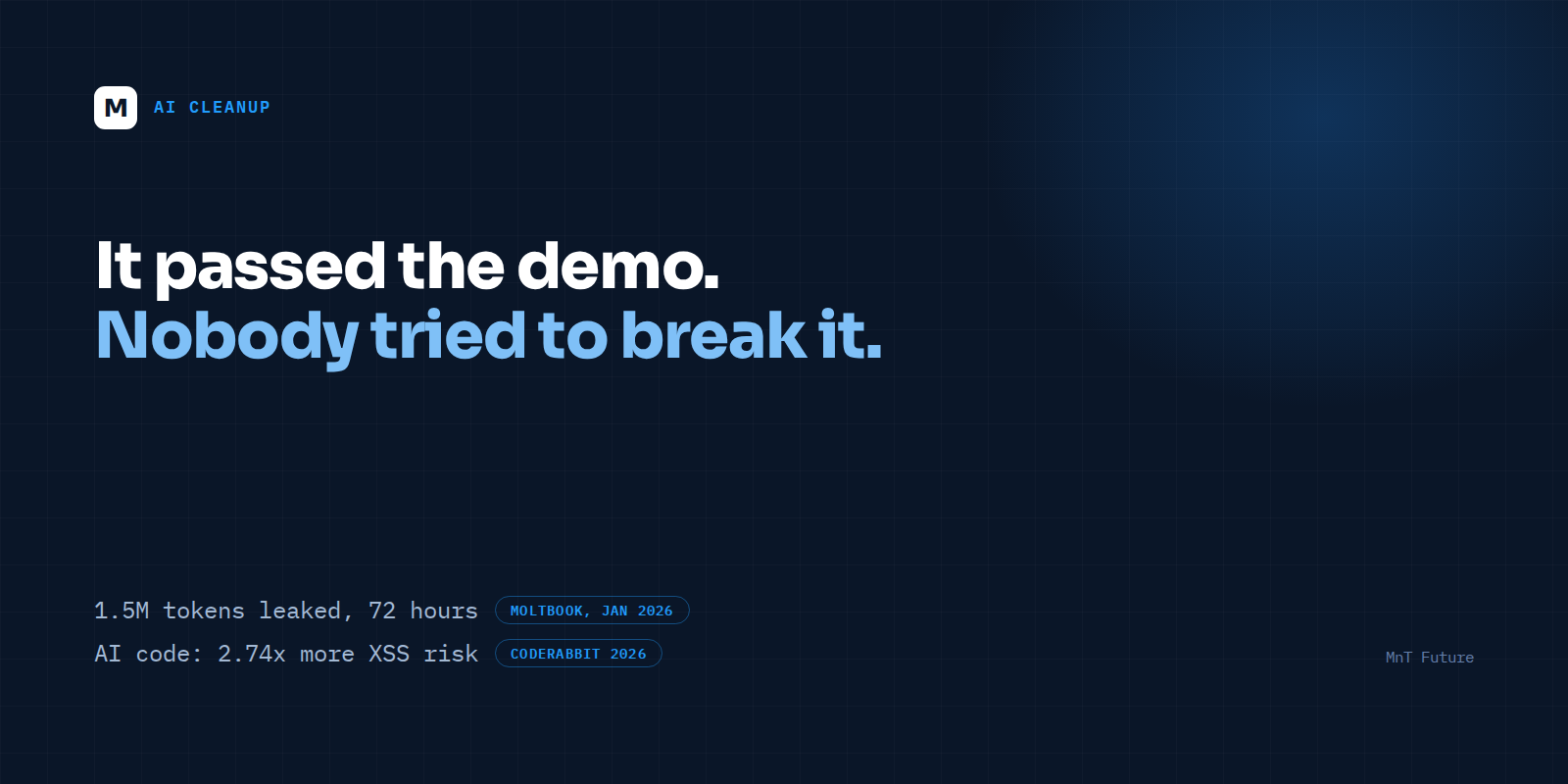
In January 2026, an application called Moltbook went live having been built entirely through vibe coding — no human-authored code in its pipeline. Within 72 hours it had leaked 1.5 million API tokens and 35,000 email addresses. Nobody wrote a line of that app by hand, and nobody caught what it was quietly exposing until the damage was already done.
That's not a story about one unlucky app. It's a preview of what happens to a lot of AI-built storefronts the moment real traffic and real customer data start flowing through them.
Quick answer: AI-built stores usually fail after launch, not before. The same models that generate code fast also skip input validation, leak secrets, and mishandle concurrency under real traffic. Hardening means a security and load audit, then rebuilding the failure points — not a full rewrite — before a breach or a Black Friday spike does it for you.
The pattern behind the breach
The Moltbook incident isn't an outlier; it's a data point in a pattern that's now well documented. CodeRabbit's analysis of 470 open-source pull requests found AI-generated code is 2.74 times more likely to introduce cross-site scripting vulnerabilities than human-written code, and 1.88 times more likely to implement password handling improperly. A CWE-based benchmark puts AI code's failure rate on XSS defense specifically at 86%.
Scale that up and the numbers get uncomfortable fast. Escape.tech scanned 5,600 live applications and found more than 2,000 vulnerabilities, over 400 exposed secrets — API keys, credentials, tokens sitting in code or config where anyone could find them — and 175 instances of exposed personally identifiable information. If your store's checkout, customer accounts, or order history were built primarily by prompting an AI tool, there is a real chance some version of that pattern is already live on your domain.
None of this means the code doesn't work. Vibe-coded stores usually do work — that's exactly why the risk is invisible. A checkout that processes a test order successfully tells you nothing about whether it validates inputs correctly, stores secrets safely, or handles a customer trying to manipulate a discount code field.
What actually breaks under real traffic
Security gaps are the part that makes headlines, but they're not the only failure mode. The second pattern shows up under load, and it's just as consistent: cache stampedes, connection pool exhaustion, and race conditions on high-traffic endpoints are now among the most common failure patterns reported in AI-assisted builds.
Translate that into commerce terms and it's specific and familiar: two customers buying the last unit of a product at the same second and both orders going through, a checkout that times out when a flash sale drives a traffic spike, an inventory count that silently drifts from what's actually in stock. An AI coding tool can generate a checkout flow that looks complete and passes a manual test. It has no way of knowing whether that flow holds up when five hundred people hit it in the same minute — because nobody asked it to, and most vibe-coded builds never get load-tested before launch.
Why "it works in the demo" isn't the same as production-ready
Part of why these gaps survive so long is organizational, not just technical. Only 12% of organizations building with AI coding tools maintain any dedicated AI governance function, and where accountability for AI-generated code does sit clearly, it's most often with a CTO or VP — who in practice has limited direct involvement in reviewing what the model actually produced. The tool moves fast. The review process usually doesn't move at all.
For a funded D2C brand or a marketplace operator, that gap is the whole problem in miniature: the store looks finished, the founder is focused on growth, and nobody has specifically checked whether the checkout leaks a secret or the inventory system survives a real spike. The store isn't broken. It just hasn't been tested against the two things that actually break stores — attackers and traffic.
What hardening an AI-built store actually takes
The instinct after reading a stat like "2.74 times more XSS vulnerabilities" is to assume the fix is a full rebuild. It usually isn't, and treating it that way wastes both time and the parts of the build that already work.
Hardening an AI-built store is a three-part process, in order.
A security and secrets audit first. Scan the codebase and configuration for exposed API keys, tokens, and credentials, and test the specific vulnerability classes AI tools reliably introduce — injection points, improper password handling, XSS. This is where a breach like Moltbook's gets caught before launch instead of after.
Load and concurrency testing second. Simulate the traffic pattern that actually matters for a commerce site — a flash sale, a promo email send, a viral moment — and watch where the checkout, inventory, and payment flows actually break, not where they're assumed to.
Targeted remediation third. Fix the specific failure points the audit and load test surfaced. Rebuild the checkout's concurrency handling if that's what broke. Rotate and properly secure any exposed credentials. Add the input validation the AI tool skipped. Leave the rest of the store — the parts that were never the problem — alone.
That's the same process MnT runs in its AI Cleanup Lab: build or receive a store with the vulnerabilities AI tools reliably introduce, demonstrate them concretely through actual exploits and load testing, then rebuild with hardened, production-grade infrastructure and measure the before-and-after. The goal isn't to prove AI-built code is worthless. It's to find precisely where it needs a senior engineer's judgment before customers — or a plaintiff's attorney, or a competitor's exploit script — find it first.
If your store was built fast with an AI tool and it's starting to carry real transaction volume, the question worth asking isn't whether it works. It's whether anyone has actually tried to break it yet. We offer a free agent-readiness audit that checks exactly that — where your AI-built store stands on security, load handling, and compliance, and what it would take to close the gap.