
Why Vibe-Coded Stores Fail Security Checks as They Scale
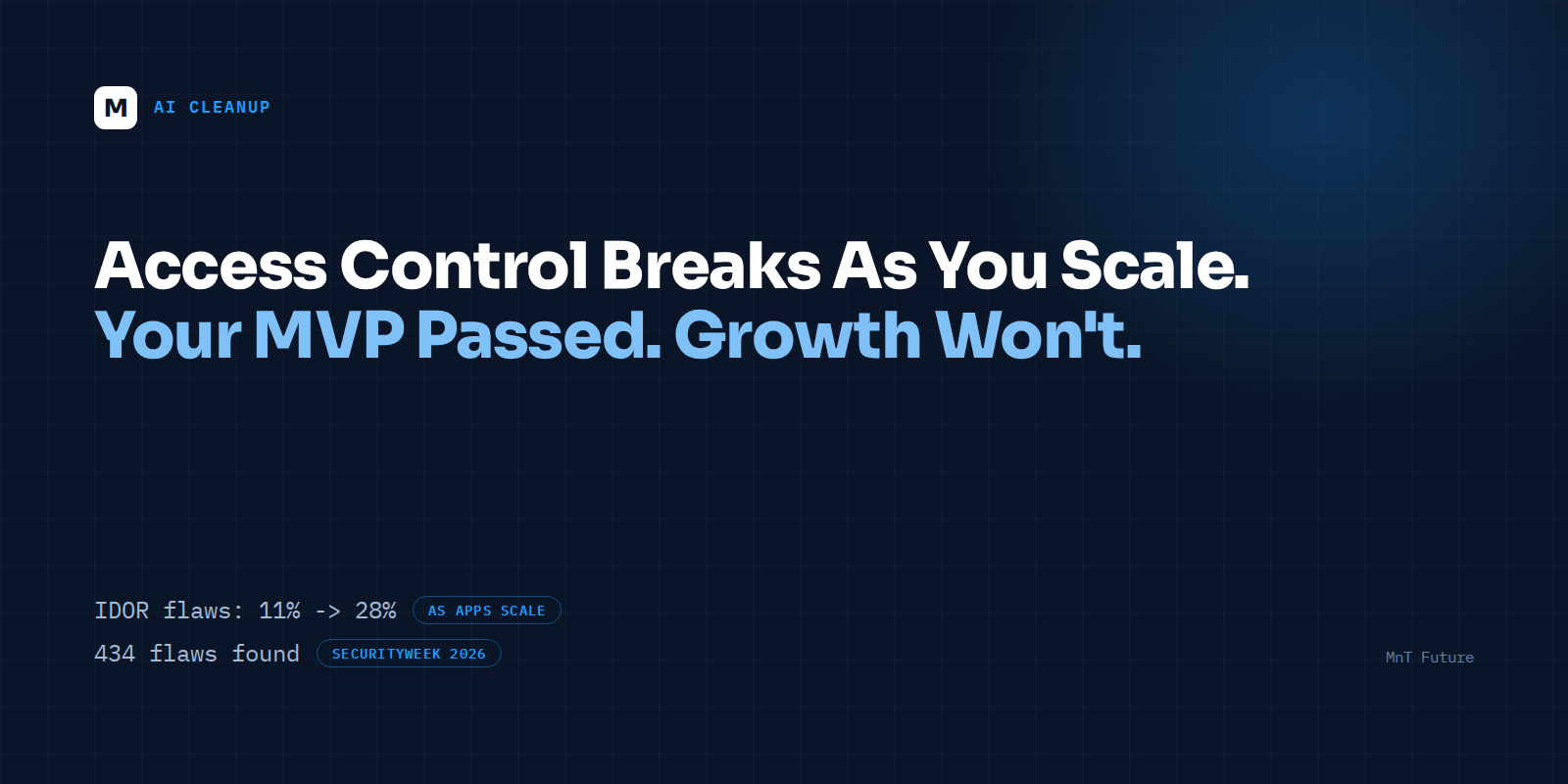
Your store passed its security review. That's exactly why you should be worried.
If you built your D2C storefront or marketplace with a vibe-coding tool, a no-code AI builder, or an AI pair-programmer moving fast on your behalf, you almost certainly ran some version of a security check before launch — a scanner, an AI code reviewer, maybe a freelance pentest. It came back clean, or clean enough. You shipped. Orders started coming in.
That early pass is not the evidence of safety it feels like. It's a snapshot of an app that was still small.
What actually breaks — and when
A July 2026 analysis of AI-generated codebases, reported by SecurityWeek and conducted by application security firm Xint.io, sampled real vibe-coded applications for exploitable flaws. Across the sample, 434 total vulnerabilities turned up. Resource exhaustion and denial-of-service issues were the single most common category. Authorization and insecure direct object reference (IDOR) flaws — where one user can reach another user's data or another account's order, cart, or payment record simply by changing an ID in a request — came in second, with 88 flaws.
The detail that matters for a growing store isn't the ranking. It's the trend line. In the smaller, greenfield application in the study, IDOR flaws made up 11% of total vulnerabilities. In the larger, brownfield application — the one with more endpoints, more features, more months of iteration — that number jumped to 28%. The researchers' own conclusion: fine-grained authorization holds up on small apps and breaks as the app grows.
That is the opposite of how most founders reason about risk. The instinct is that a store gets safer as it matures — more eyes on it, more traffic finding bugs, more time to patch. For access control specifically, in AI-generated code, the data says the reverse: the more endpoints an AI coding tool adds — a new account API, a new admin route, a new partner integration, a new mobile app hitting the same backend — the more places a permission check can be copied, forgotten, or scoped incorrectly. Nobody removed the check that was there in month one. Nobody added the equivalent check on the seventeen things built in months two through nine.
Why your first review missed it
A scanner run against a 20-endpoint MVP is checking a small surface. The same scanner, or the same AI reviewer, run against a 200-endpoint production store six months later is checking a surface ten times larger, built by an AI tool that treats each new feature as its own task rather than as an extension of a consistent permission model. Vibe-coding tools are very good at making the new feature work. They are not good, by default, at asking "does this new endpoint respect the same authorization rules as every other endpoint in this app" — because that question requires holding the whole system in view, not just the file being edited.
This is also why the fix isn't "run the scanner again." A scan tells you a flaw exists. It doesn't tell you whether your authorization model is centralized and consistent, or scattered across dozens of ad hoc checks that happened to get written correctly the first nine times and incorrectly the tenth. Closing individual IDOR findings one at a time, without fixing the underlying pattern, is how the same class of bug reappears three sprints later under a different endpoint name.
What an actual audit looks for
A real access-control review for a vibe-coded or AI-assisted store checks three things, in this order: whether authorization is enforced centrally (one policy, checked consistently) or per-endpoint (copied, and therefore inconsistent); whether every object-level lookup — order, cart, address, payment method, admin action — verifies that the requesting user actually owns that object, not just that they're logged in; and whether the newest, least-reviewed parts of the app (the features shipped last month) get the same scrutiny as the ones that have been live for a year. MnT Future runs exactly this review as part of its AI Cleanup work — the same engagement type that took a client's flawed store from 7 security findings, 2 of them critical, to 5 of 5 live exploits closed, with the infrastructure hardening that followed also producing a roughly 48x throughput improvement and a roughly 50x reduction in p99 latency, because fixing the root cause of a security gap usually touches the same code paths that were quietly slowing the store down.
The direct answer
Why do AI-generated stores fail access-control audits as they scale? Because fine-grained authorization checks in AI-generated code are typically written per-endpoint rather than enforced by a central policy. As a vibe-coded app grows from a handful of routes to hundreds, the odds that at least one new endpoint is missing or misapplying that check rise sharply — one July 2026 study found IDOR flaws climbing from 11% to 28% of total vulnerabilities between a small and a large AI-built app.
What to do before your next growth spurt, not after
If your store started as a weekend build and is now taking real orders, the honest move is to treat the code that shipped fast as a first draft, not a finished product. That doesn't mean a full rebuild — most of what a vibe-coded MVP got right (the product idea, the UX, the speed to market) is worth keeping. It means a focused audit of exactly where authorization lives in your codebase, before an attacker — or a payment processor's compliance team — finds the gap for you.
If you're not sure whether your store's access control is centralized or copy-pasted, that's the first question worth answering. MnT Future offers a free agent-readiness and security audit for stores built with AI or no-code tools — a fast way to find out whether you're looking at a scanner-clean app or a genuinely hardened one, before your next feature push makes the gap bigger. Get in touch for a free strategy session, or start with the audit.