
UCP Breaking Changes: Is Your Store Still Agent-Ready?
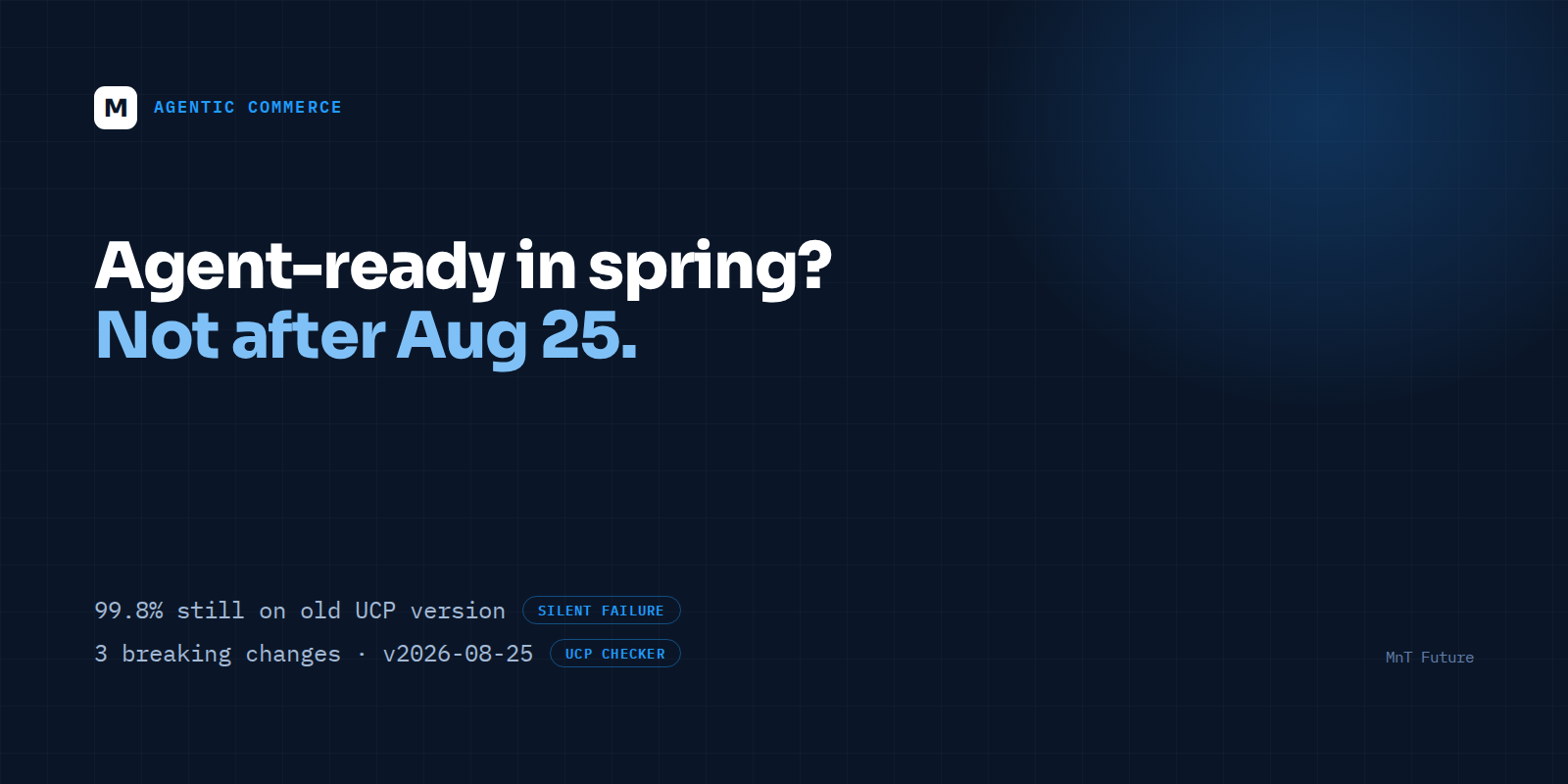
A US D2C team ships Universal Commerce Protocol support in the spring. The checklist says "agent-ready," the ticket closes, and everyone moves on. Then on August 25, 2026, the protocol they built against changes underneath them, and nothing in their dashboard says so.
That is the real story of the latest UCP release. The new features are useful. The breaking changes are the part that matters to anyone who already integrated.
What changed on August 25
The UCP release dated v2026-08-25 (published on the protocol's GitHub repository) contains three breaking changes:
- Fulfillment schema restructure. Configuration flags dropped the "allows_" prefix, fulfillment option descriptions moved from flat strings to structured objects, and merchant fulfillment configuration was consolidated into a business-level config file.
- Buyer consent overhaul. Consent moved from fixed boolean fields to a dynamic map keyed by reverse-DNS identifiers, each carrying a purpose object.
- Signing keys. The signing_keys field was removed, and keys[] (a JWK Set) became the only canonical mechanism.
The same release added vendor-neutral 3D Secure 2 support, payment schedules (deposits and installments), split payments across multiple instruments, and, per Search Engine Journal's coverage, grocery capabilities and standardized store hours.
The additions are not footnotes. Vendor-agnostic 3D Secure 2 speaks to the authentication and fraud questions that have slowed agent checkout, while payment schedules and split payments open deposits, installments and multi-instrument payments, which matter most on higher-ticket D2C and B2B baskets. Each new capability is also a new surface that your checkout, tax and fraud logic must handle correctly before you advertise it.
Why the failure is silent
Agents do not file bug reports. If your UCP profile is malformed, the agent simply does not transact with you, and you never see the sale you did not get.
UCP Checker, a third-party tracker of UCP storefronts, analyzed the release and flagged two traps. First, a profile that declares a version must declare that same version on every dev.ucp.* service entry, and mismatches are silently rejected. Second, the AP2 mandate capability moved to a new namespace, which can break validators and analytics pipelines that key off the old string. The same analysis notes that signing_keys was deleted outright rather than deprecated. Treat these as third-party findings and verify them against the release notes for your own integration.
Is there a deadline?
No mandatory migration date appears in the release notes, and Search Engine Journal reports that businesses can keep supporting earlier versions while they update. So the risk is not a cliff. It is drift.
The numbers show how real drift is. On release day, UCP Checker reported 99.8% of verified stores still on the previous 2026-04-08 version, with none on the new one. The tracker now lists 18,759 verified stores. Agents and platforms will increasingly negotiate against the newest profile, and a store that never revisits its integration slowly falls out of the set of stores they can transact with cleanly.
Who is exposed
Shopify handled its side. Its September 4 changelog says storefronts now advertise 2026-08-25 support at /.well-known/ucp, and developers need to do nothing.
The exposure sits elsewhere: custom and headless storefronts with their own UCP layer, marketplaces that built a protocol adapter in-house, and brands relying on a third-party connector that pinned a version and has not been touched since launch.
What should a brand do about UCP breaking changes?
Answer-engine block: Audit your UCP profile against the latest release notes, confirm every service entry declares the same protocol version, replace signing_keys with a keys[] JWK Set, and update consent and fulfillment schemas. Then run a test transaction through an agent flow. If you use Shopify's hosted UCP, no action is needed.
A plausible failure sequence
Consider how this happens without anyone being careless. A team updates the profile's version string to the new release but leaves one service entry on the old one. Or a connector library keeps publishing signing_keys because nobody told it otherwise. The profile still loads in a browser and passes a quick visual check. An agent's validator rejects it, and the only trace is a gap in the sales you expected. Nothing here requires negligence, only the absence of a test that behaves like an agent.
A drift-proof setup: five checks
- Assign an owner. Someone's name should be next to "UCP version." Protocols without owners decay.
- Test against the spec in CI. Validate your profile and payloads against the schemas in the protocol repository on every release tag, not only on your own deploys.
- Run a synthetic agent transaction weekly. Discovery, cart, checkout in test mode, end to end. This is the only check that proves an agent can actually buy.
- Monitor /.well-known/ucp. Alert on non-200 responses, invalid JSON and version mismatches across service entries.
- Isolate the protocol behind an adapter. Keep canonical product, price, inventory and fulfillment data in one layer, and translate to UCP at the edge. When the spec changes, one adapter changes, not your catalog.
What this means for agent-readiness
Agent-readiness behaves like a payments integration, not a landing page. It has versions, dependencies, failure modes and an on-call story. Brands that treat it as a launch task will be surprised by the next revision, and the one after.
At MnT Future, we build agent-ready commerce as an adapter layer over canonical commerce data, so a spec revision is a contained change instead of a rewrite. If you want to know where your store stands today across UCP, ACP and Retail MCP, start with a free agent-readiness audit. We will show you what your profile declares, what an agent can actually complete, and what to fix first.
Sources: UCP v2026-08-25 release notes (github.com/Universal-Commerce-Protocol/ucp); Search Engine Journal, Aug 31, 2026; Shopify developer changelog, Sept 4, 2026; UCP Checker (ucpchecker.com).