
AI Shoppers Land on Your Product Page, Not Your Homepage
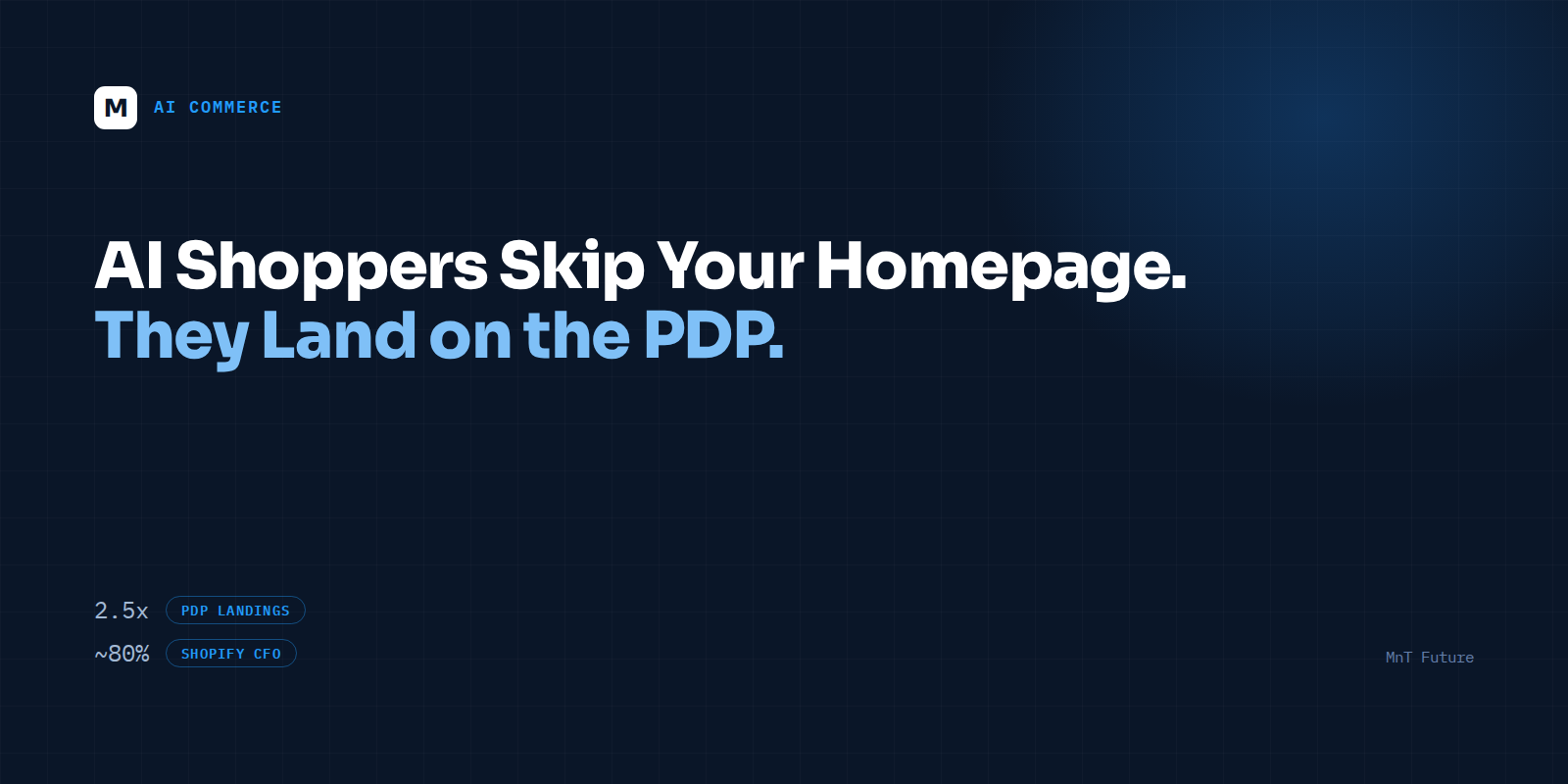
Your homepage went through three design reviews this year. Your best-qualified new visitors will never see it.
At the Goldman Sachs Communacopia + Technology Conference on September 10, 2026, Shopify CFO Jeff Hoffmeister said that when a shopper starts in a large language model, they are "2 and a half times more likely to end up right on the product page" than shoppers arriving by other routes. He added that Shopify has seen "roughly an 80% uplift in conversion." Separately, Blend Commerce, citing Shopify's Q1 2026 data, reports that 55% of AI-referred sessions begin on a product detail page, against about 20% for organic search.
Two cautions before acting on this. The 80% figure is Shopify's own, stated on an investor call without a published methodology. And other datasets on AI-referred traffic point the other way. We would not plan a budget around any single number. The direction is what matters: the product page is now the front door, and most product pages were never built to be one.
What the AI already did before the click
A shopper who arrives from an AI assistant has usually finished the top half of the funnel inside the chat. They described a need, saw options compared, and were handed one product. They arrive with a question that is narrower than a browser's: is this the one I was told about, and is what I was told true?
A product page designed for browsers assumes the visitor came through a collection page. It leans on the homepage for brand trust, the category page for comparison, and the navigation for policies. An AI-referred visitor skipped all of it.
The answer engine block: what should a product page do when AI sends the shopper?
A product page receiving AI-referred traffic must confirm what the assistant said, then remove remaining doubt in place. That means matching price, stock, and variant to the quoted data; stating brand positioning, fit, delivery date, and returns on the page itself; and answering follow-up questions without forcing the shopper to navigate elsewhere.
Five jobs the product page now has to do
1. Match what the agent quoted
The fastest way to lose a pre-qualified shopper is a mismatch: the assistant said $48 and in stock, the page says $52 or "select a size" with the size out of stock. That is rarely a design problem. It is a data problem. The assistant, the feed it reads, and the page render from different sources, updated on different schedules. The fix is one canonical product and inventory record that all three read. Copy edits cannot fix a sync gap.
2. Carry the brand on the page
Blend Commerce makes the point well: the product page now has to work as a standalone website. Who you are, why this product over the alternative, and what makes the brand credible have to sit within a scroll of the buy button, because the homepage that used to say it is no longer in the path.
3. Answer the follow-up questions in place
The shopper's next questions are specific: does it fit my use, is it compatible with what I own, how does it differ from the cheaper one. If the page can't answer, the shopper goes back to the chat, and a chat that answers those questions may recommend someone else. A well-scoped assistant or structured Q&A block on the page keeps the question inside your store.
4. Put the decision facts at the decision point
Delivery date, return terms, and payment options belong beside the buy button, not two clicks away in a footer. This is the context a homepage-to-checkout journey would have supplied gradually.
5. Measure the landing, not the site
Sitewide conversion rate blends AI-referred product-page entries with everything else and hides the signal. Segment sessions by entry page type and referrer, and judge the product page on its own entry cohort. If you cannot separate them today, that is the first thing to fix.
Where a shopping assistant belongs
The instinct is to bolt a chat widget onto the site. The better placement is on the product page, with the product already in context. At MnT Future, our own reference build, MnT Commerce, runs semantic search, a shopping assistant, and an ops agent on one shared product and inventory model. Because the assistant and the storefront read the same record, the answer in the chat and the number on the page cannot disagree. We are describing an architecture here, not quoting a conversion lift; we have no measured figure to publish for it and won't invent one. See our AI search and recommendations work for how this fits together.
A 30-day audit you can run without a rebuild
- Pick your ten highest-traffic product pages. Ask an AI assistant about each and record the price, stock, and variants it quotes.
- Compare against the live page. Log every mismatch and trace each one to its data source.
- Read each page as a stranger who has never seen your homepage. Note what a new visitor can't learn without leaving the page.
- Move delivery, returns, and brand proof next to the buy button on the pages that fail.
- Split your analytics by entry page and referrer so AI-referred landings are visible.
If steps one and two show more than a couple of mismatches, do not rewrite copy yet. Fix the data path first.
What we would not do
We would not build a separate "AI landing page" for each product. It adds a second page to keep in sync and solves the wrong problem. We would also not treat Shopify's 80% as a benchmark for your store. Treat it as a reason to check whether your product pages survive a visitor who arrives already convinced and only needs the page not to break the promise.
Next step
If you'd like a second pair of eyes, MnT Future offers a free agent-readiness audit that includes how your product pages and product data hold up when an AI assistant sends the shopper. Book it through our contact page, or ask for a free strategy session.
Sources: PYMNTS, "Shopify Says AI Search Boosts Conversions by 80%" (2026); Investing.com coverage of Shopify at Goldman Sachs Communacopia + Technology, Sept 10, 2026; Blend Commerce, "Product Pages as AI Search Landing Pages" (citing Shopify Q1 2026).