
No ADA Web Rule for Private Business — Lawsuits Soar
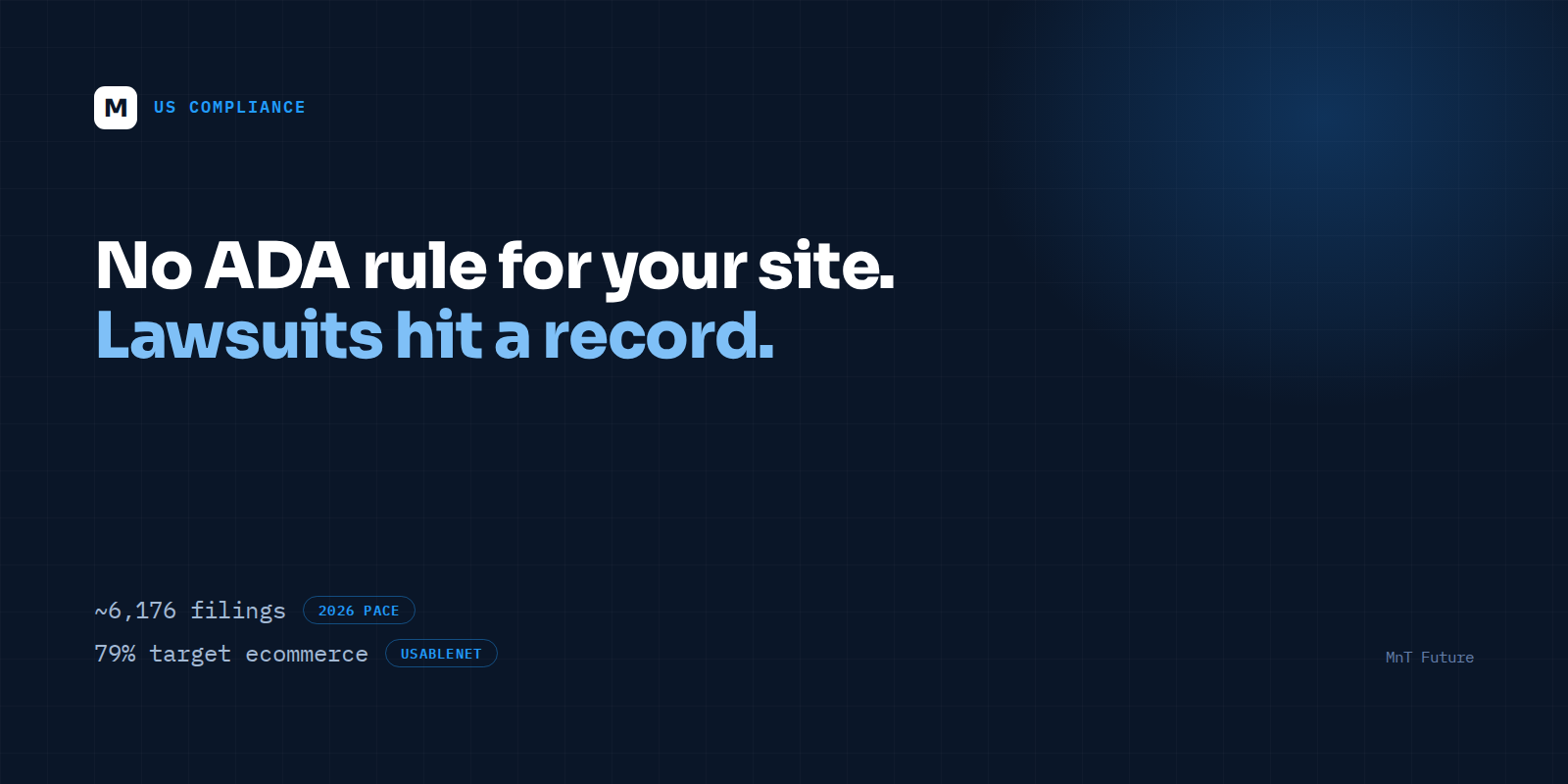
Ask your general counsel which federal regulation requires your ecommerce site to meet a specific accessibility standard, and the honest answer is: none. Not yet, not in writing. Title III of the Americans with Disabilities Act — the section covering privately owned businesses open to the public — has never had a website-specific rule from the Department of Justice. No published technical standard, no compliance deadline, no safe harbor. For years, that gap read as breathing room. In 2026, the data says the opposite.
The Rule That Still Doesn't Exist
In April 2024, the DOJ finalized a rule requiring state and local government websites — Title II of the ADA — to meet WCAG 2.1 Level AA, with compliance deadlines of April 24, 2026 for larger entities and April 26, 2027 for smaller ones. In April 2026, the DOJ extended both deadlines by roughly a year, pushing them to April 2027 and April 2028. That extension applies only to government sites.
Title III, the section that governs private commerce, has no equivalent. The DOJ announced in October 2025 that it intended to "re-examine" ADA rulemaking across both titles, which could eventually extend a codified WCAG standard to private business. As of this writing, it hasn't, and no timeline has been published for when — or whether — it will.
Is a private ecommerce website legally required to meet an ADA accessibility standard?
No federal regulation sets a technical standard for private ecommerce under ADA Title III. Courts and DOJ settlements treat WCAG 2.1 Level AA as the practical bar, and 2026 lawsuit volume against ecommerce sites is on pace for a record ~6,176 filings.
The Lawsuits Aren't Waiting for a Regulation
UsableNet's 2026 midyear tracking puts total ADA digital accessibility lawsuits on pace for approximately 6,176 filings this year — around 20% above 2025 and the highest volume recorded to date. Ecommerce absorbs the overwhelming majority of that volume: 79% of all filings target ecommerce specifically, with every other industry combined making up the remaining 21%.
The profile of who gets sued has also shifted upmarket. In 2026, 36% of companies named in accessibility filings had annual revenue above $25 million — not small direct-to-consumer shops testing an unfamiliar space, but the kind of established, well-resourced brand that assumes it has scale and legal counsel working in its favor. Filings are also migrating toward state courts: New York remains the largest single venue, Illinois has emerged as a fast-growing one driven substantially by a handful of specialized plaintiff firms, and Florida and California stay active as well. The pattern researchers point to is straightforward — when federal rulemaking and enforcement slow, private plaintiffs fill the gap.
Why No Regulation Means More Risk, Not Less
The absence of a codified Title III rule doesn't remove the standard buyers are judged against — it removes the certainty. Courts and settlement agreements have consistently treated WCAG 2.1 Level AA as the practical benchmark for "readily accessible" under Title III, even without the DOJ having written it into a formal regulation. That leaves a private brand held to essentially the same technical bar as a government website, minus the fixed deadline, published guidance, and safe harbor an actual rule would provide. There's no regulation to point to as evidence of compliance, because none exists — the defense that works for a permit or a tax filing simply isn't available here.
This is the gap MnT Future sees most often in accessibility engagements: a brand treats "no law, no risk" as a reason to defer the work indefinitely, right up until a demand letter cites the same WCAG success criteria the DOJ already made mandatory for every government website in the country.
What This Means for B2B and Wholesale Portals
Established B2B and wholesale sellers often assume accessibility litigation is a direct-to-consumer problem, not theirs — a login-gated wholesale portal feels like a private tool rather than a public storefront. Courts haven't read Title III that narrowly. A portal that any business customer can request access to, or that markets itself publicly before gating checkout behind a login, has repeatedly been treated as a place of public accommodation in ADA litigation. Combined with the fact that over a third of 2026 defendants already carry real revenue and real legal budgets, a B2B or wholesale brand assuming it's below the radar because it isn't a consumer storefront is betting against the current data.
What an Actual Fix Looks Like
The industry has largely settled the question of whether overlay widgets solve this — they've drawn an FTC settlement over deceptive "automatic compliance" claims and continue to appear on a meaningful share of sites that get sued anyway. A real fix starts with a code-level audit of the actual rendered page: contrast ratios, keyboard focus order, form labeling, heading structure, tested against every key template with a tool like axe-core, then remediated in the design system so the fix holds everywhere that component is reused, not just on the one page that got tested. MnT Future's own WCAG 2.x AA remediation — seven failing checks taken to zero across nine key page templates, verified with axe-core, no overlay involved, is the kind of documented audit trail that holds up if a demand letter arrives, and it's the same ongoing compliance work we build for clients rather than a one-time consulting engagement.
Ready to know where your site actually stands? MnT Future offers a free strategy session to walk through your ADA/WCAG posture — before a demand letter does it for you.