
Inside MnT Commerce: Our Cross-Functional Agent Stack
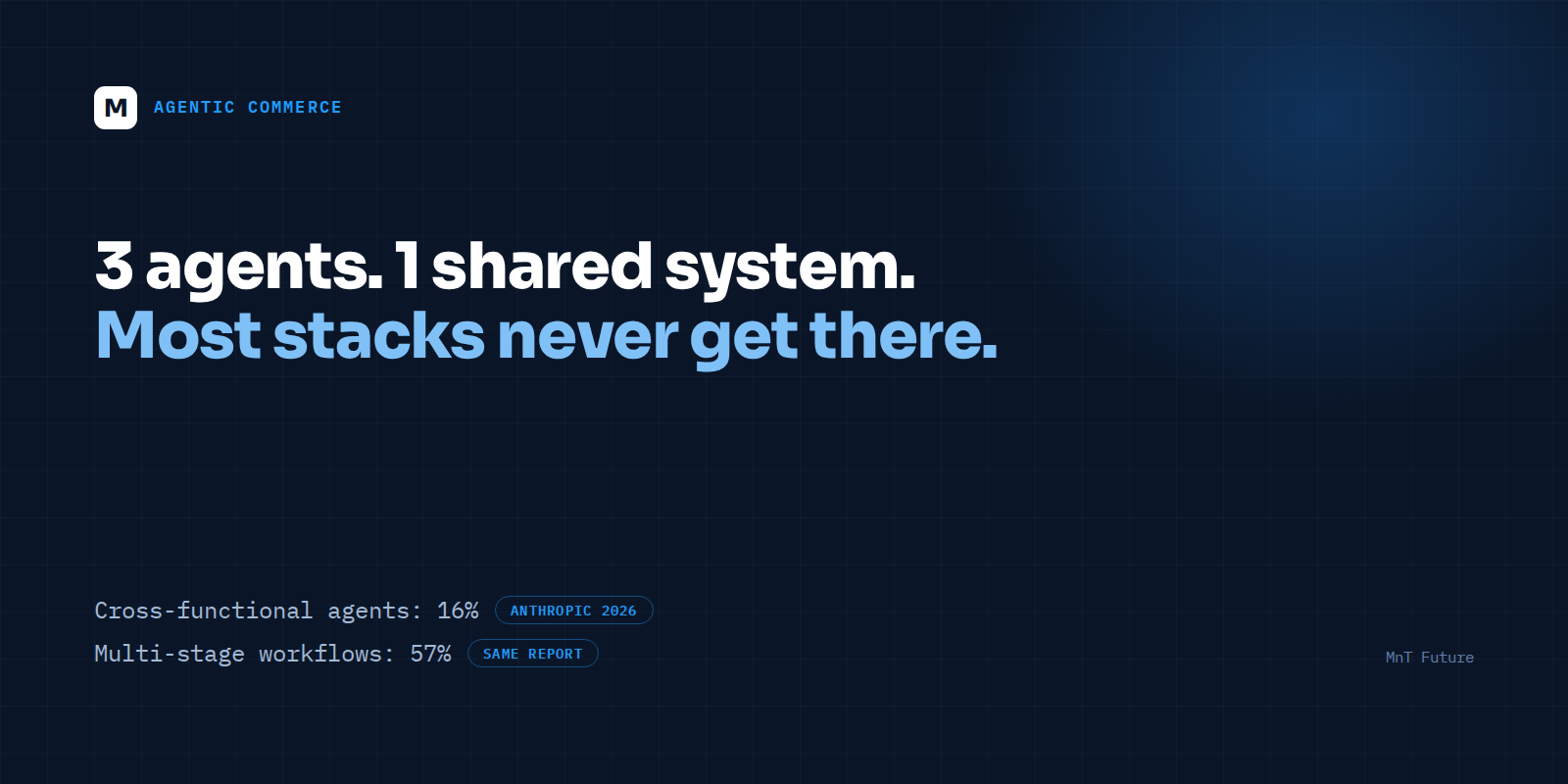
Most ecommerce brands that experiment with AI agents end up with three unconnected pilots: a semantic search box the merchandising team owns, a shopping assistant the support team owns, and — if they're lucky — an alerting script somewhere that nobody fully trusts. Each one works in a demo. None of them share what they know about a customer, a product, or an order. That gap between "we have an agent" and "our agents work together" is bigger, and more common, than most vendor pitches let on.
New research puts a number on it. Anthropic's 2026 State of AI Agents Report — a survey of more than 500 US technical leaders across company sizes and industries, run in late 2025 with research firm Material — found that 57% of organizations now use agents to handle multi-stage workflows. Only 16% have progressed to cross-functional or end-to-end processes that span multiple teams or business functions. In plain terms: most companies have an agent. Few have gotten agents to actually talk to each other.
We didn't want to sell agent-ready commerce without living inside that gap ourselves, so we built MnT Commerce — our own internal platform, and the system we use to test every architectural decision before it goes into a client build.
What "cross-functional" actually means on a storefront
It's easy to say three agents work "together." It's more useful to say exactly what that requires, because the requirement is the part most stacks skip.
Semantic search that understands intent, not just keywords
Baymard Institute's 2026 benchmark of on-site search across 170+ sites found that query types like Feature, Symptom, Compatibility, and Use Case fail 2 to 4 times more often than simple Exact or Product Type queries. A shopper who searches "something for sensitive skin that won't clog pores" needs a system that understands the request, not one that matches "sensitive" against a product title. MnT Commerce's search layer is built to parse that kind of query and return relevant products — the same semantic layer we scope for client storefronts.
A shopping assistant with access to real inventory and pricing
A shopping assistant that can chat but can't see live stock, real pricing, or fulfillment windows is a scripted FAQ with better manners. The assistant on MnT Commerce reads from the same product and inventory data the storefront runs on, not a static knowledge base refreshed once a week — because the whole point of a shopping assistant is being right at the exact moment someone is deciding whether to buy.
An ops agent that watches the platform, not just the storefront
The piece most vendors leave out entirely is the operational layer: something watching the system itself for the kind of failures a customer never sees directly but definitely feels — a sync error, a pricing mismatch, an inventory count drifting out of true. MnT Commerce runs an ops agent for exactly that job, on the same platform the search and assistant agents run on.
Why the cross-functional step is where most stacks stall
Three separate agents each need their own tuning, their own failure modes, and their own owner. That's tractable — most teams can ship one working agent in a quarter. What's hard is the layer underneath all three: one product and inventory data model all of them read from, one place where a change made by the ops agent is visible to the assistant a minute later, and one team that's accountable when something breaks across all three instead of three teams each pointing at the other two. That's an architecture decision, made early, not a feature you bolt on once the first agent ships. It's also exactly the decision most teams don't make until it's expensive to unmake — usually right around the point where the second agent's local copy of "what's in stock" quietly disagrees with the first agent's.
There's a reason this is where adoption stalls rather than at the first agent. A single agent can fail privately — a bad search result, a slightly-off recommendation — and nobody outside the team notices. Cross-functional failures are public by definition: a customer sees the assistant say one thing and the checkout page say another. That's a higher bar, and it's the bar Anthropic's research suggests 84% of organizations that have adopted any agent at all still haven't cleared.
MnT Future runs into this question on every build, because it's the same decision whether the client is a funded D2C brand adding a shopping assistant or a marketplace operator wiring an ops agent into a live inventory system. Building MnT Commerce internally first means we've already made — and paid for — that decision before it shows up in a client's timeline. It's the same instinct behind treating an AI Cleanup Lab engagement as R&D before we sell it, taking our own accessibility work to zero failing checks before we audit anyone else's, or building LOBBI's AI booking agent to actually complete a transaction before recommending one to a client: proof before pitch.
What this means if you're evaluating an agent-ready commerce partner
The honest version of this: a demo of one agent tells you almost nothing about whether a vendor can get you to the cross-functional 16%. A polished shopping-assistant demo is the easiest thing in this entire space to fake for thirty minutes. Ask harder questions instead. Does their search agent's data feed the same source their shopping assistant reads from, or are they two teams' separate exports of the same catalog? Does anything watch the system itself, or just the storefront a customer sees? Who owns the failure when two agents disagree about what's in stock — and how would you even find out that happened, before a customer complains? If those questions get vague answers, the pilot you're being sold is one of the 57%, not the 16%.
We'd rather show you where your own store sits against that same question than tell you where we think it sits. That's what a free agent-readiness audit is for — a straight assessment of your current search, assistant, and operational tooling against ACP, Google UCP, and Retail MCP readiness, not a sales deck disguised as diagnostics.
What does a cross-functional AI agent stack for ecommerce actually mean?
Most ecommerce brands run AI agents in isolation — a search tool here, a chatbot there — with no shared data layer between them. A cross-functional agent stack connects semantic search, a shopping assistant, and an operational monitoring agent to one product and inventory data source, so all three see the same real-time state. Only 16% of companies have reached this stage (Anthropic, 2026).
Curious where your store actually stands? Get a free agent-readiness audit from MnT Future and see exactly what it would take to move your stack from isolated pilots to one connected system — or book a free strategy session to talk through your architecture first.