
Why the Junior Developer Shortage Threatens Ecommerce
If you've priced out an ecommerce rebuild or a new marketplace build this year, you've probably run into the same pitch twice: a dev shop that's "AI-augmented," staffed mostly with junior and mid-level engineers, moving fast and charging less. It sounds like a reasonable bet in 2026 — AI writes the boilerplate, junior engineers wire it together, everyone ships faster for less money. There's just one problem with that plan, and it isn't a technology problem. It's a labor-supply problem, and it's getting worse every quarter.
The apprenticeship pipeline AI quietly deleted
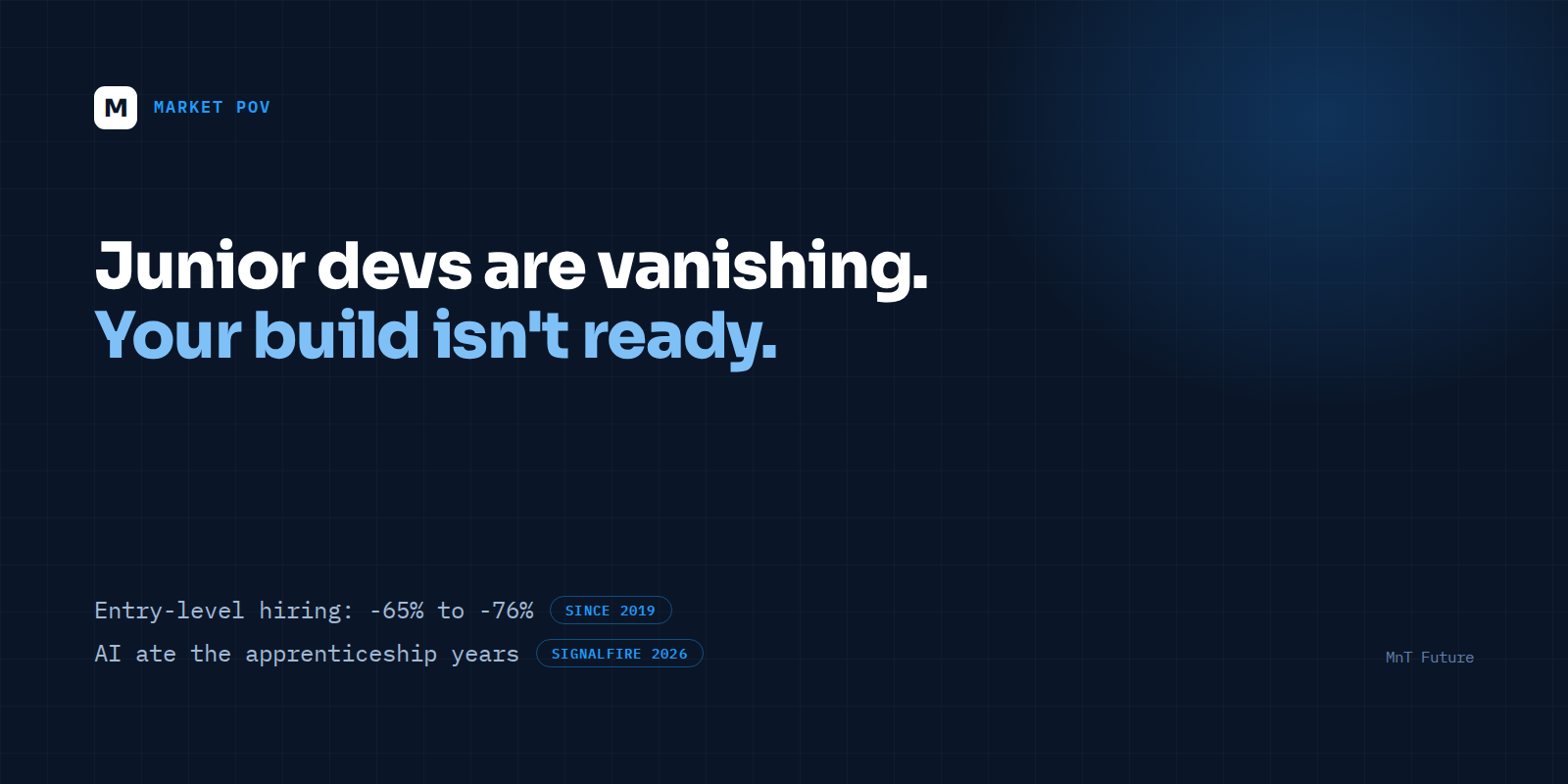
SignalFire's 2026 State of Talent Report tracked hiring across large tech companies and early-stage startups against a 2019 baseline, and the numbers are stark: new-grad and entry-level hiring has fallen roughly 65% at major tech companies and about 76% at early-stage startups. Graduates from the top 20 U.S. computer science programs are now 45% less likely to land a job at a large tech company than graduates from those same programs a few years ago.
The report's explanation is the part that matters for anyone building a commerce platform right now. The jobs that disappeared weren't senior architecture roles or platform-ownership roles — they were the entry-level tasks that used to teach a junior engineer how to become a senior one: writing boilerplate code, running unit tests, doing routine debugging. AI now does that work directly. It's faster and cheaper than paying a junior engineer to learn on the job, so companies stopped hiring juniors to do it.
That's a genuinely good outcome for productivity. It's a genuinely bad outcome for anyone who assumed the junior-engineer pipeline would keep quietly producing next year's mid-level developers and the year after's seniors. The apprenticeship model that trained most of the senior engineers working today no longer exists in the form that trained them.
Why this changes how you should vet a dev partner
Here's the part most buyers miss: AI-generated code doesn't reduce the need for senior judgment. It relocates it. Someone still has to decide whether the architecture is right, whether the AI-suggested approach will hold up under Black Friday traffic, whether a "working" pull request actually handles the edge case that matters for split payments or multi-state sales tax. That work has always required a senior engineer's judgment. It still does — arguably more than before, because the code arrives faster and in greater volume, and every batch still needs the same review.
So when a dev shop pitches "AI-augmented delivery" staffed mostly by junior and mid-level engineers, the honest question isn't whether their tools are current. It's who is actually reviewing what the AI produces, and whether that person has the experience to catch what a first read misses. A junior engineer reviewing AI-generated code is, structurally, the least equipped person on the team to do it — the review requires exactly the judgment a junior hasn't had the apprenticeship years to build, and per SignalFire's data, increasingly won't get the chance to build through entry-level tech roles at all.
Quick answer: Entry-level tech hiring has fallen roughly 65% at large firms and 76% at startups since 2019 (SignalFire, 2026), because AI now automates the boilerplate coding juniors used to learn on. That pipeline collapse — right as AI-generated code needs senior review — makes senior-only delivery a structural requirement for a production-ready ecommerce platform, not a luxury.
What a junior-heavy, AI-augmented build actually costs you
This isn't theoretical. MnT Future runs an internal R&D case study called the AI Cleanup Lab, built specifically to test what happens when a store gets shipped fast on AI-assisted junior-level output: a deliberately flawed store, built the way a junior-plus-AI team plausibly would, then stress-tested with real exploits and load testing before being rebuilt with hardened infrastructure. The failure pattern was consistent — the code worked in the demo and broke under the conditions a senior engineer would have flagged in review: security gaps that passed a first read, and performance limits that only showed up under real traffic. None of it was exotic. All of it was the kind of thing a junior reviewer, however AI-assisted, is the wrong person to be the last line of defense against.
For a US D2C or marketplace brand, that failure mode shows up at the worst possible time — a peak sales weekend, a payment integration under load, an accessibility or PCI gap that surfaces in an audit instead of a code review. The commerce platforms built to survive that aren't the ones with the most AI tooling. They're the ones where a senior engineer owned the review, the architecture, and the production decision, every time.
The vetting question worth asking this quarter
Before you sign with any commerce development partner in 2026, ask directly: what percentage of the engineers touching my platform are senior, and who signs off before code ships to production? If the honest answer is "mostly junior and mid-level, AI-assisted," you're not buying speed. You're buying the exact labor-supply gap SignalFire just measured, with your storefront as the test case.
Senior-by-default isn't a marketing line. Given where entry-level hiring is headed, it's becoming the only staffing model that can actually deliver an AI-assisted commerce platform without the AI doing more damage than good.
If you want a second opinion on how your current platform — or a proposal you've just received — would hold up under that standard, MnT Future offers a free agent-readiness audit and a free strategy session for US D2C and marketplace brands: a straight look at where your commerce platform stands today, and what a senior-only build would change.