
17 States Dropped the 200-Transaction Sales Tax Rule
If your business sells wholesale — repeat buyers, standing orders, a lot of small-ticket reorders — there's a decent chance you registered for a sales tax permit in a state you didn't need to be in. Not because your revenue crossed a threshold there, but because your order count did. For years, most states copied South Dakota's original economic nexus test almost word for word: $100,000 in sales OR 200 separate transactions, whichever came first. For a D2C brand selling a handful of $150 orders, that 200-transaction line rarely mattered. For a wholesale seller processing dozens of small reorders a week for the same accounts, it was often the thing that actually triggered nexus — sometimes at a fraction of the revenue threshold.
That rule is quietly disappearing, and most sellers haven't updated their nexus map to reflect it.
Where the 200-Transaction Rule Came From
The 2018 Supreme Court decision in South Dakota v. Wayfair let states tax remote sellers without a physical presence, as long as the seller crossed an economic threshold. South Dakota's own statute set that bar at $100,000 in sales or 200 transactions in the state, and most states that followed copied the same dual test. The transaction count was meant as a backstop for high-volume, low-price sellers who might do real business in a state without ever crossing the dollar figure. In practice, it mostly caught marketplace resellers and wholesale accounts with a lot of small, recurring orders.
The Shift: 17 States Have Dropped the Transaction Count
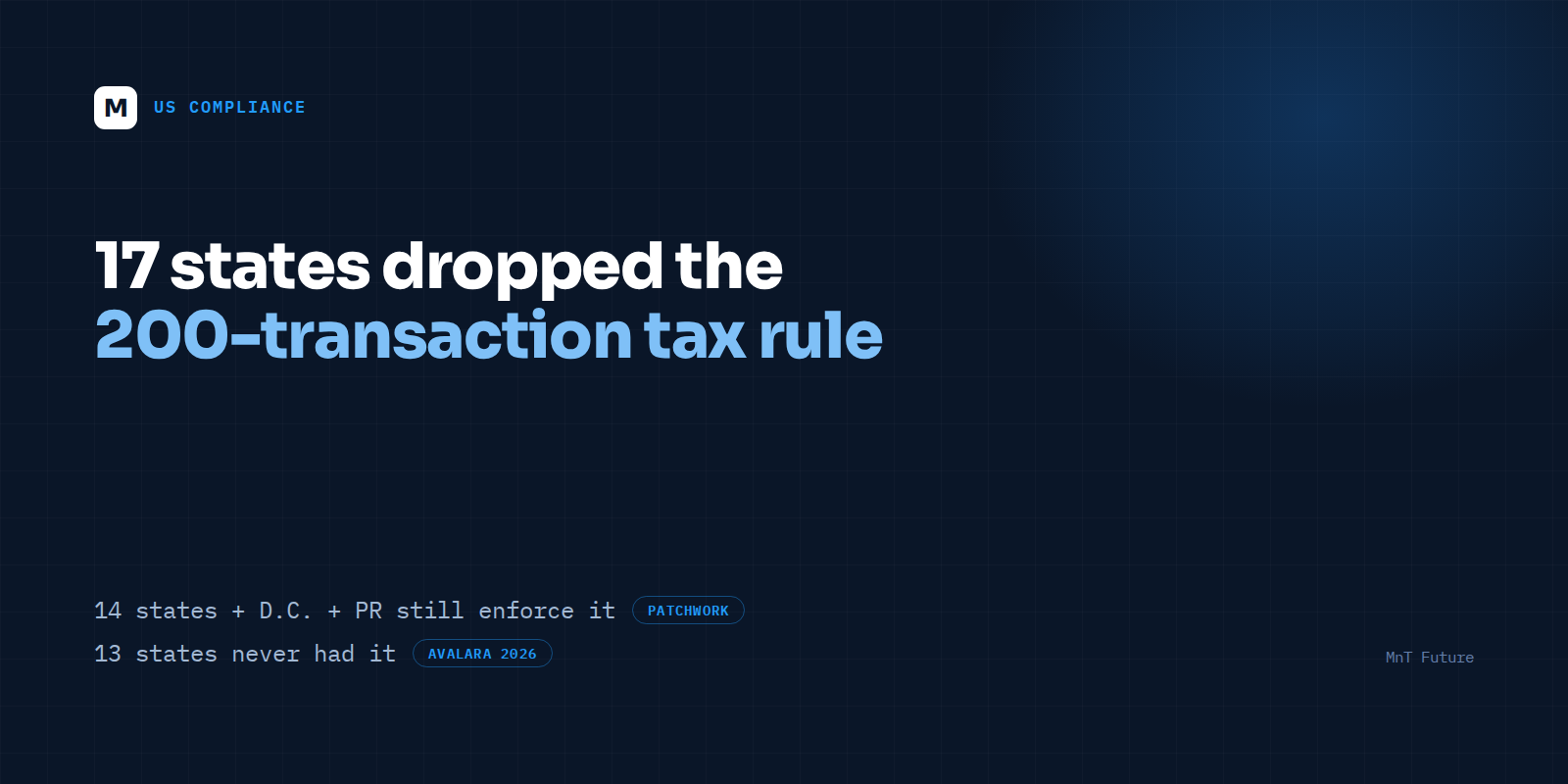
According to Avalara's nexus tracker, 17 states have eliminated the 200-transaction threshold entirely, leaving only the revenue test. The list, current through August 1, 2026: California, Colorado, Illinois (effective January 1, 2026), Indiana, Iowa, Kentucky (effective August 1, 2026), Louisiana, Maine, Massachusetts, North Carolina, North Dakota, South Dakota — the state that started all this — Utah, Washington, Wisconsin, and Wyoming, plus Alaska's local-tax jurisdictions through the Alaska Remote Seller Sales Tax Commission. Avalara reports one nexus consultant's observation that roughly a third of their clients with under $50,000 in in-state sales had been required to register solely because they crossed 200 transactions — a real compliance cost for revenue that barely moved the needle.
What Hasn't Changed
Thirteen states never adopted a transaction threshold at all — Alabama, Arizona, Florida, Idaho, Kansas, Mississippi, Missouri, New Mexico, Oklahoma, Pennsylvania, South Carolina, Tennessee, and Texas have always used revenue alone. And 14 states, plus Puerto Rico and Washington D.C., still enforce the 200-transaction count alongside a dollar threshold. Avalara names New Jersey as the state most likely to be next. The result is a genuine three-bucket map — never-had-it, dropped-it, still-has-it — that shifts every legislative session, not a single national rule a seller can memorize once.
What This Means for a Wholesale or B2B Seller
If your business has a lot of small recurring orders, you may now have fewer active filing obligations than your last nexus study found — worth checking before you keep paying for registrations and filings you no longer need. The reverse is also true: if you assumed the transaction count didn't matter because your dollar volume was low, you may still be exposed in the 14-plus states that kept it. Either way, a nexus map built in 2019, or even in early 2025, is not a safe thing to still be operating from in September 2026.
A practical way to re-check exposure without hiring a full nexus study: pull a state-by-state breakdown of the last 12 months of orders, sorted by both dollar revenue and transaction count. For each state, compare both numbers against that state's current rule — not last year's rule. States where you clear the revenue threshold need attention regardless of transaction count. States where you're under the revenue line but historically crossed 200 orders are exactly the ones worth re-checking against this year's eliminated-threshold list, since that's where a filing obligation may have quietly gone away.
The Real Risk Isn't the Rule Change — It's How Your Platform Handles It
Most sellers don't actually calculate nexus by hand; they lean on a tax engine like Avalara, TaxJar, or Stripe Tax. Where this bites is when a commerce platform's checkout, invoicing, or B2B order flow has that tax logic hardcoded or duct-taped in rather than cleanly integrated — a threshold change becomes a developer ticket and a re-test cycle instead of a configuration update the tax engine handles on its own. That's the kind of thing MnT Future builds against by default: commerce platforms, B2B/wholesale portals, and marketplace backends where tax, compliance, and inventory logic are integrated properly rather than bolted on, specifically so state-level rule changes like this one don't require touching application code. Compliance built in from the architecture stage is cheaper than compliance retrofitted after a state legislature moves.
As of August 2026, 17 US states have eliminated the 200-transaction economic nexus threshold, leaving only a revenue-based trigger — commonly $100,000 — for remote-seller sales tax registration. Fourteen states plus Washington D.C. and Puerto Rico still enforce the transaction count alongside revenue, and 13 states never had one. Sellers with high order volume and modest per-order revenue should re-check every state's current rule before assuming their last nexus study still holds.
Where to Start
Pull your current state-by-state sales activity and check it against each state's live threshold — not the one you last checked. If you're not sure whether your commerce platform's tax integration is actually built to absorb a rule change like this without a code deploy, that's a conversation worth having before the next state drops its threshold. This isn't a one-time fix, either — the pattern of the last two years suggests another state will move within the next few months, and a platform that handles that gracefully once will keep handling it. MnT Future offers a free strategy session for US D2C and wholesale brands who want a second set of eyes on where their platform and their compliance obligations actually stand, and it's a fair question to ask before your next state registration renewal, not after. See also our WCAG 2.x AA compliance audit case study for how we treat compliance as an architecture problem rather than a bolt-on fix.