
ChatGPT Just Became an Ad Platform. Are You Ready?
Your Shopify store might already check the boxes on last month's "agent-ready" list — a UCP integration flipped on, product schema validated, robots.txt updated to allow AI crawlers. Then, on September 16, 2026, OpenAI changed what "ready" means again.
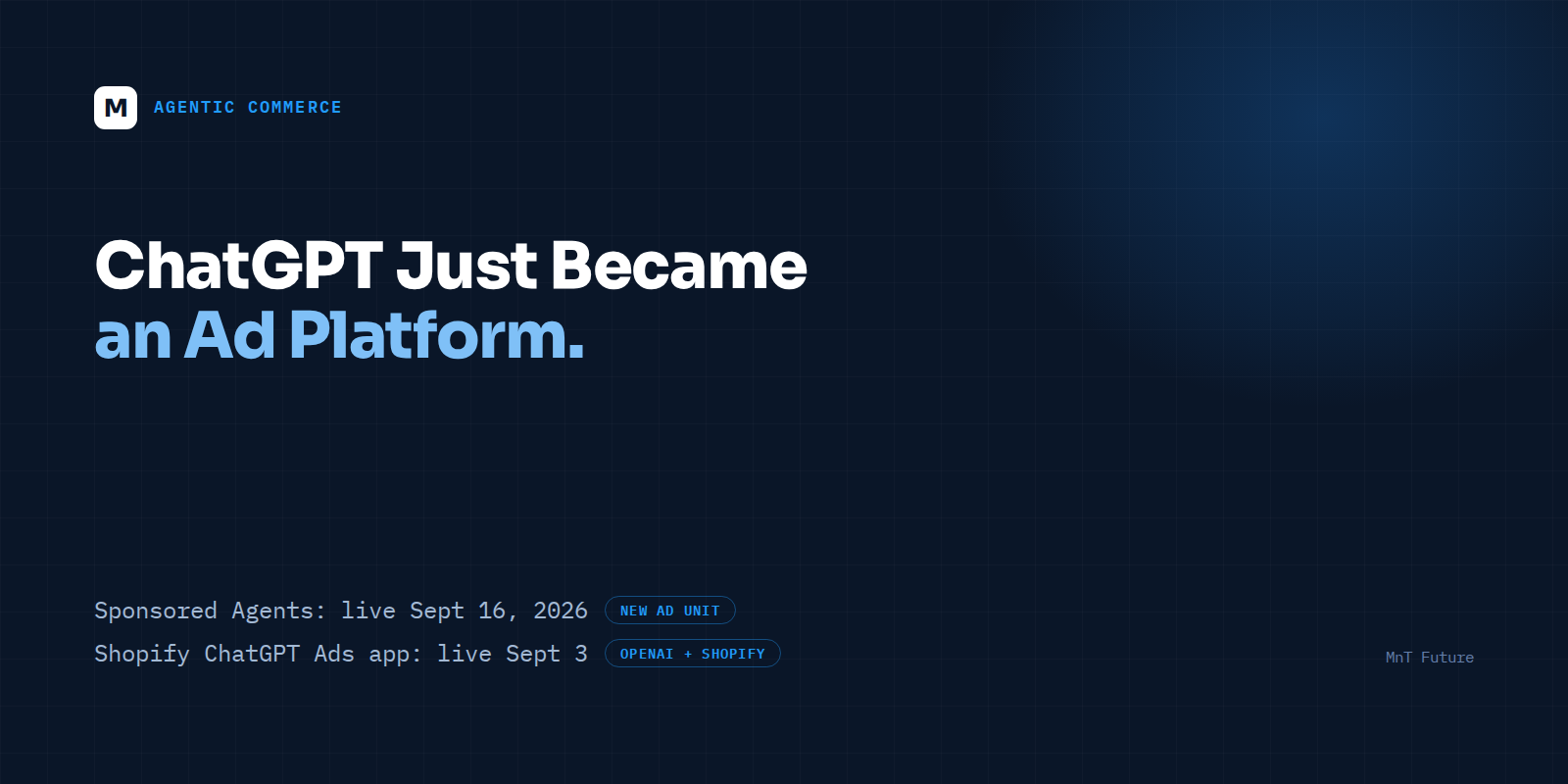
OpenAI began testing Sponsored Agents inside ChatGPT: a new ad unit where clicking an ad opens a separate, clearly labeled conversation with the advertiser's own AI agent, right inside the chat window, before the shopper ever lands on a website. The feature is currently limited to select US advertisers. Shopify shipped the plumbing thirteen days earlier — a free ChatGPT Ads app in the Shopify App Store, live September 3, that syncs a merchant's product catalog automatically, installs a server-side conversion pixel, and hands campaign management back to the familiar Shopify admin. HubSpot got the same integration on announcement day, with international Shopify availability following on September 23. Advertisers register at ads.openai.com or inside the app they already use.
For a funded D2C brand that spent the summer worrying about UCP, ACP, and Retail MCP, this is a new variable: agentic commerce now has a paid lane running parallel to the organic one.
Why an Ad Layer, Not a Checkout Layer
The timing isn't an accident. OpenAI and Stripe launched Instant Checkout inside ChatGPT in September 2025, then quietly discontinued it in March 2026 after retailers — Walmart among them — reported in-chat completed-purchase rates running roughly a third of what the same traffic converted at through a normal click-out. Getting an agent to complete a transaction reliably, at scale, turned out to be the harder problem. Getting an agent to hold a sponsored conversation and hand the shopper off to the brand's own site is a much older, better-understood mechanic — it's search advertising with a chat interface. OpenAI monetized the part that already worked.
That's a useful signal for where to spend engineering time this quarter: not a bespoke in-chat checkout build, but the catalog and product-data foundation that makes any agent conversation — sponsored or organic — actually good.
The Catalog Problem Nobody's Pricing In
A Sponsored Agent talks from a brand's own product data. If that data is thin — missing sizes, stale prices, no real answer to "does this work for X" — the sponsored conversation doesn't just underperform, it actively embarrasses the brand inside a labeled, attributable ad unit. That's a materially worse outcome than a low-CTR banner nobody remembers seeing.
It's also the identical requirement organic agent discoverability already demands. Whether an AI agent finds a product through Google's UCP, negotiates a transaction through ACP, or reads a Retail MCP server, it's reading the same underlying signal: structured, accurate, current product data — GTINs, live availability, pricing, and the attributes that answer the question a shopper is actually asking. Sponsored Agents didn't invent a new technical requirement. They put a price tag and a public audience on the requirement that was already there.
What to Check Before Bidding
Three things worth verifying before a Shopify brand turns on the ChatGPT Ads app:
- Catalog completeness — every SKU that could show up in a sponsored conversation needs current price, real-time stock, and the attributes a shopper actually asks about, not just a title and a hero image.
- A conversation, not a landing page — the agent is answering follow-up questions live. If the honest answer to a likely question lives in a PDF spec sheet or a support ticket queue instead of structured product data, the agent will guess, and a guess inside a paid, branded conversation is worse than saying nothing.
- A test budget sized for a pilot, not a channel — this launched September 16 with select US advertisers. Treat the first spend as a scoped experiment with a defined read window, not a reallocation of the whole paid-social budget.
Sponsored Agents are a ChatGPT ad unit OpenAI began testing September 16, 2026: clicking an ad opens a labeled conversation with the advertiser's own AI agent inside ChatGPT. Shopify shipped an integration app September 3, 2026. Brands need clean, structured product data before buying in — the same foundation organic agent discovery already requires.
This is the same audit MnT Future runs when a brand asks for an agent-readiness check — product data first, protocol second, ad spend third. Skipping straight to buying Sponsored Agents on top of a thin catalog just makes the gap visible faster, and in public.
Agent-Readiness Now Has Two Lanes
Organic and paid used to be separate strategies with separate teams. Inside agentic commerce, as of this month, they run on the same foundation. UCP, ACP, and Retail MCP make a brand discoverable and transactable by agents for free. Sponsored Agents make a brand's own agent show up inside someone else's conversation for a fee. Both read from the same product data. A brand that fixes that data once, and exposes it correctly, is ready for whichever lane moves first — and right now, given what shipped this month, that's the paid one.
Where This Goes Next
Shopify's international rollout lands September 23. Expect other platforms — BigCommerce, Salesforce Commerce Cloud, and Adobe Commerce already support ACP, UCP, or AP2 in some combination — to ship comparable ad integrations within a quarter, once the Shopify pilot data is public. The brands ahead of that curve won't be the ones who reacted fastest to the announcement. They'll be the ones whose product data was already clean when the option showed up.
If your team hasn't run a real audit of what an AI agent — sponsored or organic — actually sees when it reads your catalog, that's the place to start before the next platform ships its version of this. See how agent-ready commerce works, look at proof from builds like Searchlight and MnT Commerce, or book a free agent-readiness audit to see exactly where your store stands against UCP, ACP, and Retail MCP — and whether your catalog is ready to be talked about, paid or not.