
B2B Wholesale Portals: Build the Reorder Engine First
A B2B buyer who already knows exactly what they're reordering — the same 40 SKUs, the same quantities, maybe one seasonal swap — should never have to call a rep to place that order. Most wholesale portals still make them do something close to it: hunting through a catalog UI built for first-time browsers, re-keying line items one at a time, waiting on a phone call to confirm pricing that should already be sitting there, correct, the moment they log in.
That gap is now backed by two separate 2026 data points, and they point at the same conclusion from different directions.
The buyer wants out of the sales conversation
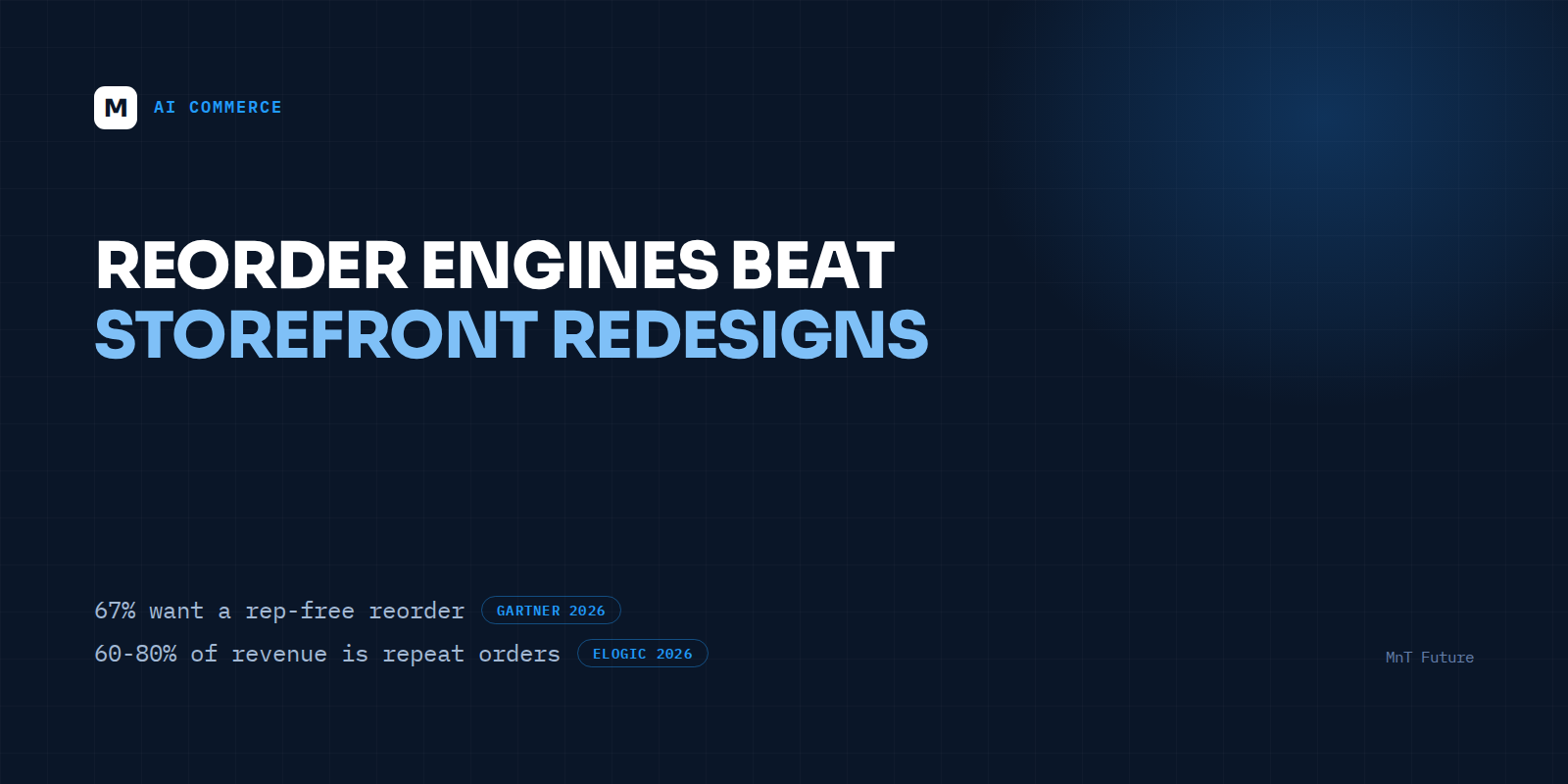
Gartner surveyed 646 B2B buyers between August and September 2025 and published the results in March 2026: 67% now say they prefer a rep-free purchasing experience, up from 61% the year before. 45% had already used AI during a recent purchase. Buyer journeys, Gartner's researchers note, are becoming steadily more self-directed and digitally mediated — fewer early touches with a human sales rep, more independent navigation straight to a decision.
That is not a preference wholesale sellers can design around. It is the buyer telling the seller, directly, what the portal is for.
The revenue is already sitting in reorders
Separately, Elogic Commerce's B2B Ecommerce ROI Report 2026 found that 60-80% of B2B revenue comes from repeat and replenishment orders — the "core B2B revenue engine," in the report's own framing — and that self-service adoption rate, meaning the share of total orders placed through the portal rather than by phone, email, or fax, is the single strongest predictor of whether a wholesale portal actually pays back its build cost.
Put those two numbers together and the priority order for a B2B wholesale portal project inverts. Most build budgets go toward the parts a buyer sees first — a modernized product page, a cleaner category browse, better on-site search. Those matter for a first-time buyer. But 60-80% of the revenue moving through the portal belongs to buyers who already know what they want, and 67% of them have said they'd rather never talk to a rep to get it. The feature that revenue depends on isn't the storefront. It's the reorder engine.
What a reorder engine actually is
A reorder engine is the set of workflows that let a repeat buyer place a large, accurate order fast, without browsing:
- Quick order by SKU or part number, with autocomplete against the buyer's own purchase history
- Saved order templates and one-click reorder of a previous order, adjustable before checkout
- CSV or spreadsheet upload for multi-line orders, common for buyers reordering 50+ line items at once
- For larger accounts, punchout catalog integration (cXML or OCI) — letting the buyer's own procurement system browse and requisition directly against the seller's live catalog and contract pricing, without the buyer leaving their own purchasing software
None of these are exotic. What makes them hard is what sits underneath them, and that's where most portal projects run out of budget before they finish.
Why the reorder button is the easy 20% and the hard 80%
A reorder button is trivial to mock up. It is not trivial to make correct, because correctness depends on two things being current at the moment the buyer clicks it: the price, and the stock.
B2B pricing is rarely one price per SKU — it's contract pricing, volume tiers, and account-specific negotiated rates, all of which live in the ERP, not the storefront's product catalog. Inventory has the same problem: a reorder that shows an item as available when the warehouse is actually out is worse for trust than showing no reorder option at all, because it breaks the exact promise the feature was built to keep. A buyer who gets burned once on a phantom-in-stock reorder goes back to calling a rep — permanently.
That means the real engineering work on a wholesale portal isn't the reorder screen. It's the integration layer connecting that screen to the ERP in something close to real time — event-driven sync where the platform supports it, tight-interval polling where it doesn't, and a clear answer to what happens when the two systems disagree, because they eventually will.
How do you build a B2B reorder engine that buyers trust?
Pair self-service order workflows — quick order, saved templates, CSV upload, and punchout for larger accounts — with a live or near-live integration to the ERP for pricing and inventory, so what a repeat buyer sees at checkout matches what's actually true. The engine, not the storefront, is what captures the 60-80% of revenue already coming from reorders.
This is the layer MnT Future builds first on a wholesale portal project — the pricing and inventory integration underneath the reorder screen, not just the reorder screen itself — because a fast, well-designed reorder flow sitting on a stale data feed doesn't survive contact with a real buyer for more than one bad order.
For a marketplace or B2B/wholesale operator scoping a portal build or evaluating why an existing one isn't converting repeat buyers, the diagnostic question is simple: when a buyer clicks reorder, how old is the price they're seeing, and how old is the stock number? If the honest answer is "since last night's batch job," that's the project — not another storefront redesign.
Ready to find out where your reorder workflow actually stands? MnT Future offers a free strategy session to walk through your current portal architecture and pinpoint what's between you and self-service revenue you're already leaving on the table.