
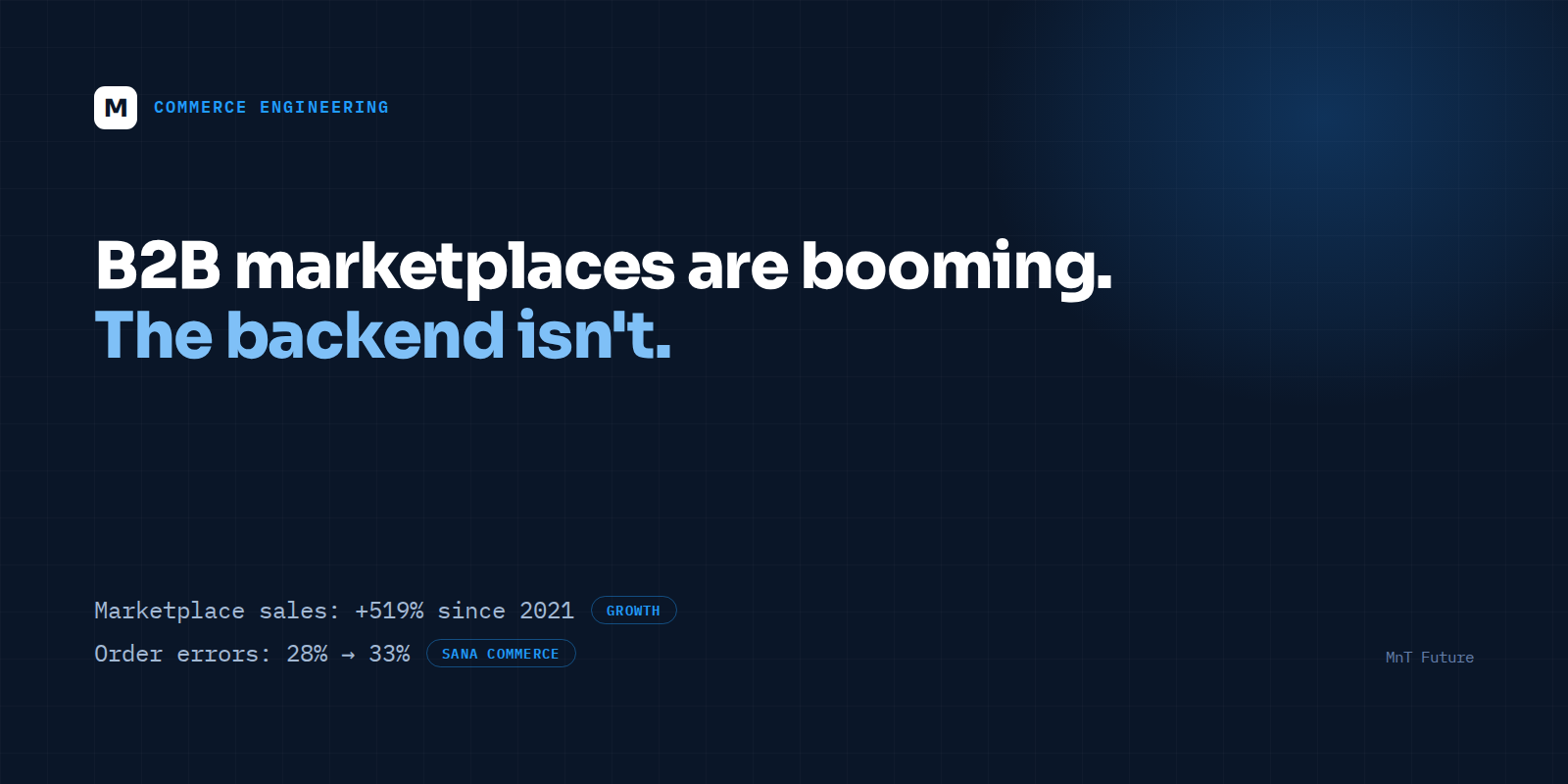
B2B Marketplaces Are Booming. The Backend Isn't.
A wholesale buyer places an order on a multi-vendor marketplace. The confirmation email goes out instantly. Three vendors later, one of them discovers the item sold out on their own channel an hour earlier — the marketplace's inventory feed just hadn't caught up. Now there's a cancellation, a manual refund split across two payment accounts, and a buyer who was told, in writing, that 91% of B2B buyers would switch suppliers over an experience exactly like this one.
That scenario is playing out more often, not less, and the data explains why.
US B2B marketplace sales grew 519% between 2021 and 2024, reaching roughly 14% of all B2B commerce, according to Digital Commerce 360. Self-service B2B portals went from something less than seven in ten platforms offered to 85% of them in a single year, per DynamicWeb's 2025 research. By every adoption metric, marketplace commerce is the fastest-growing lane in B2B.
The uncomfortable number sits right next to it: B2B online order error rates climbed from 28% in 2019 to 33%, according to a 1,000-respondent Sana Commerce study. Growth and error rate are moving up together. That's not a coincidence — it's what happens when the storefront scales faster than the systems underneath it.
Quick answer: B2B marketplace order errors are rising even as adoption grows because most platforms scale the storefront — new vendor onboarding, catalog pages, checkout flows — without rebuilding the backend that tracks inventory across vendors and reconciles split payments in real time. The fix isn't a better UI; it's event-driven inventory sync and idempotent payment orchestration underneath it.
Where the growth actually breaks something
Two systems carry almost all of the operational weight in a multi-vendor marketplace, and both are invisible until they fail.
Real-time inventory across vendors
A single-seller store only has to reconcile its own stock. A marketplace has to reconcile N vendors' stock, each updating on their own schedule, against one buyer-facing catalog that has to be right the moment someone checks out. Most platforms that started as a storefront-first build handle this with periodic syncs — every few minutes, sometimes hourly — because that's what the ecommerce platform they started on supports natively. At low order volume, the gap between "vendor sold it" and "marketplace knows it's sold" is invisible. At the growth rates the market is currently posting, that gap is where the cancellations, the double-sells, and the manual refunds live.
Split payments across vendors
Every order on a multi-vendor marketplace is really several transactions wearing one checkout: a platform commission, a payout to each vendor, sometimes a shipping partner cut. Getting that right once is a configuration task. Getting it right at scale — with holds, partial refunds, disputed line items, and vendors onboarding and offboarding continuously — is a ledger problem, and ledger problems don't forgive periodic batch jobs. A split-payment system built as an afterthought on top of a single-ledger checkout is the second most common place marketplace operators discover their backend can't carry the volume their storefront is now attracting.
What a backend built to carry this growth actually requires
Three things, in order of how often they get skipped:
- Event-driven inventory, not scheduled syncs. Inventory changes should propagate the moment a vendor's stock moves — via webhooks or a message queue — not on a five-minute cron job. This is an architecture decision made at the data layer, not a plugin.
- Idempotent split-payment logic. Every payment split needs to be safely re-runnable without double-charging or double-paying a vendor if a webhook fires twice or a network call times out. This is the difference between a payment system that survives a bad network day and one that generates a support ticket every time one happens.
- A reconciliation layer that assumes failure. Vendors' systems will occasionally lag, a payment provider will occasionally retry, a webhook will occasionally arrive out of order. A backend built for marketplace scale treats that as the normal case to design for, not an edge case to patch later.
The same pattern shows up off the marketplace, on the B2B/wholesale side. Self-service portal adoption jumped from under seven in ten platforms to 85% in a single year, per DynamicWeb — but a portal is only as trustworthy as the systems wired into it. A wholesale buyer who reorders through a self-service portal is trusting that the stock number on screen matches a warehouse or ERP system that, more often than not, updates on its own schedule — nightly, sometimes weekly. The same event-driven principle that fixes a marketplace's vendor-inventory gap fixes a wholesale portal's ERP-sync gap: propagate the change the moment it happens, not on the next scheduled batch run. It's the same integrations-and-automation problem wearing a different front end.
We built exactly this stack for LOBBI, a two-sided marketplace we engineered end to end, with an embedded AI booking agent across three apps — real-time inventory and slot availability, and split payments handled through Cashfree.
If your marketplace is growing the way the market currently is — and the 519% growth number says most are — the question worth asking isn't whether the checkout page converts. It's whether the system underneath it was built to carry today's order volume, or the order volume you had when you launched. That's the gap our custom marketplace builds are built to close — we run a free strategy session to map it for your platform, before it shows up as a cancellation email to one of your buyers.