
Vendor AI Claims Need Receipts: What the FTC's AI-Washing Cases Mean for US Brands
If your storefront says "AI-powered," somebody on your team should be able to answer one question: what is the evidence? For many US brands the honest answer today is a vendor's slide, and regulators have started treating that as a problem.
On May 21, 2026, the FTC announced proposed consent orders against Cox Media Group, MindSift LLC and 1010 Digital Works LLC over a marketing service called "Active Listening." According to law-firm summaries of the action, the companies told business customers the service used a proprietary algorithm to capture smart-device conversations and target ads, and the FTC alleges it did not use voice data and did not place ads as described. The three companies would pay $930,000 combined, with $880,000 of that from Cox Media Group. The orders are proposed and subject to public comment.
The details of that case are about ad targeting, not commerce. The pattern is what matters for anyone buying AI search, shopping assistants or agents for a store.
Why AI-washing is a buyer's problem now
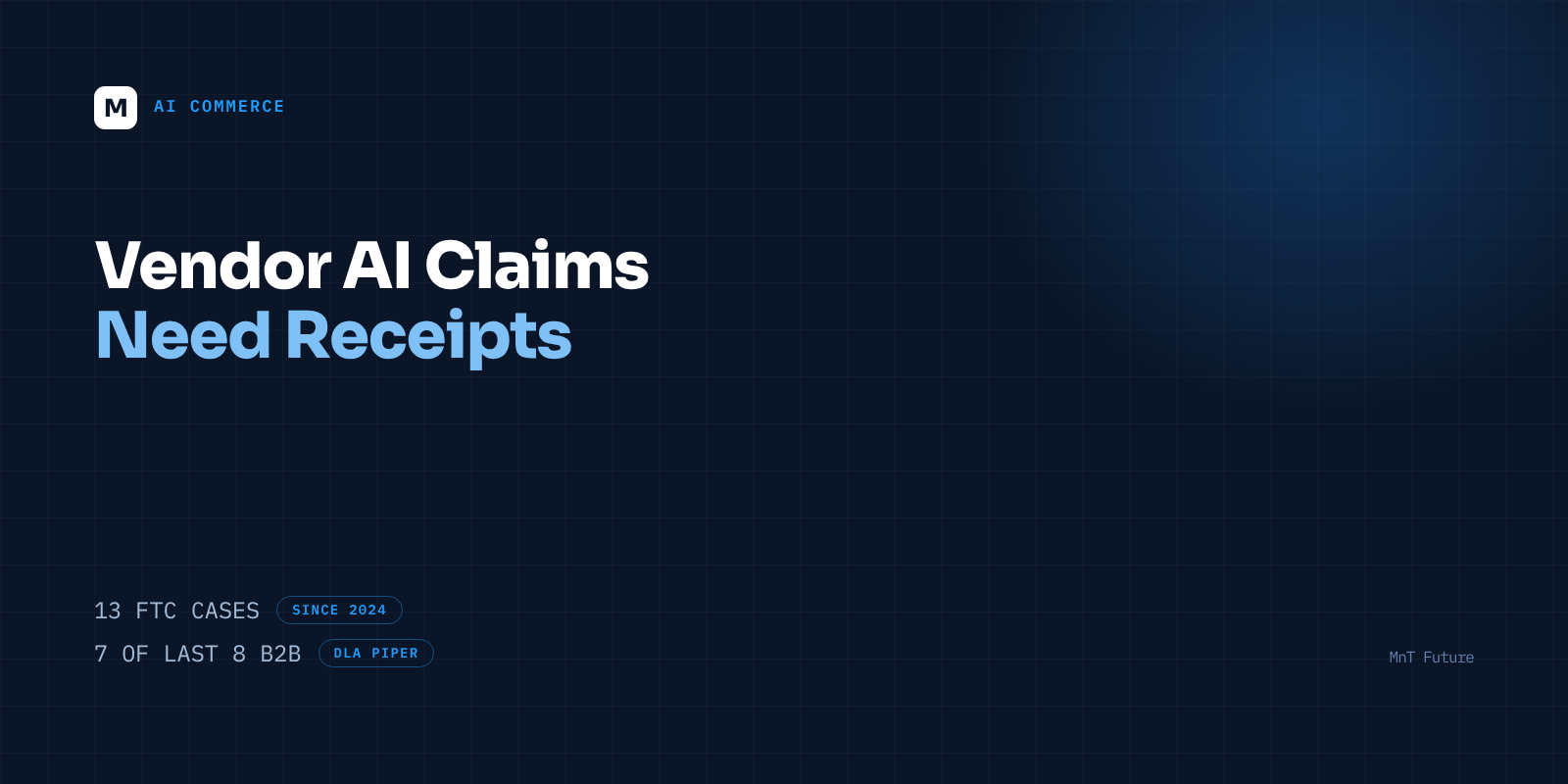
DLA Piper's analysis calls the Cox Media Group matter the thirteenth AI-washing case the FTC has brought since 2024, and notes that seven of the last eight involved claims made to other businesses rather than consumers. Holland & Knight's August 2026 review adds that the same substantiation standard applies whether the audience is a consumer or a business buyer, and that companies supplying marketing materials to others can face liability under a "means and instrumentalities" theory.
None of this makes a buyer liable for a vendor's pitch. It does change three things for a brand. First, a vendor whose claims cannot be supported is a continuity risk: an enforcement action against your platform provider is a bad quarter for you. Second, if you repeat a vendor's claim on your own site ("our AI assistant understands every question"), that sentence is now your marketing claim, held to the same expectation that it can be supported. Third, procurement teams are the cheapest place in the chain to catch an unsupported claim, because it costs one question on a call.
This is guidance for thinking about risk, not legal advice. Your counsel decides what applies to your business.
The answer-engine summary
What is AI-washing in ecommerce? AI-washing is marketing that overstates what an AI feature does. The FTC treats unsupported AI capability claims as deception and has brought 13 such cases since 2024. For brands, the test is simple: every AI claim on a vendor deck or storefront needs present-tense evidence that the feature does what the sentence says.
Five questions that separate a capability from a claim
1. "Is this live today, or on the roadmap?"
Present-tense claims need present-tense support. Holland & Knight's guidance draws the same line between current capability and future plans. A vendor who says "our assistant resolves orders autonomously" should be able to show it resolving orders, in production, now. If the honest answer is "next quarter," write that in the contract as a milestone, not a feature.
2. "What was measured, on what data, and when?"
A conversion lift needs a baseline, a sample, a time window and a method. "Customers see up to 40% more conversion" with no cohort definition is not evidence; it is a headline. Ask for the test design, not just the number. If the vendor cannot say how the figure was produced, treat it as unsupported.
3. "What does the agent do when it is wrong?"
Every shopping assistant gets product questions wrong sometimes. The useful claim is about behavior at the edge: does it hand off, refuse, or confidently invent a return policy? Ask to see the failure cases and how they are logged. A vendor that only shows successes has not told you what the system does.
4. "Which parts are the model, and which are people or rules?"
Several AI-washing cases turn on this. If a "fully automated" workflow quietly depends on human reviewers or hand-written rules, that is fine as an architecture and misleading as a label. Ask for an honest diagram of what is model, what is deterministic code, and what is a person.
5. "What will you put in writing?"
Warranty language is where confidence meets accountability. Ask which claims from the sales deck will appear in the statement of work as acceptance criteria. Claims a vendor will not sign are claims worth discounting.
What to keep as a record
The best defense for your own storefront copy is a short evidence file kept at the time the claim goes live: the vendor's test results, your own acceptance test, the date, and who approved the wording. The point is not paperwork for its own sake. When someone later asks "how do you know?", you can answer in a minute rather than a quarter.
How MnT Future approaches its own claims
MnT Future builds commerce platforms and AI agents for US D2C and marketplace brands, and we hold ourselves to the same questions. When we describe a result, it comes with its source. For example, Searchlight, our autonomous SEO agent, cut open issues by 70% after its first AI pass; that is a measured result from our own build, not a client outcome, and we label it that way. Our accessibility audit took seven failing axe-core checks to zero across nine key pages, and we say plainly that automated checks are one layer of compliance, not the whole of it.
The principle is smaller than it sounds: say what the system does, show how you know, and cut the sentence if you cannot.
What to do this week
Pull every AI claim from your storefront, your product pages and your vendor decks into one list. Next to each, write the evidence you hold and the date. Where the evidence column is empty, either get the evidence or change the sentence. That one-hour exercise will tell you more about your AI vendors than another demo.
If you want a second pair of eyes, MnT Future offers a free agent-readiness audit for your store, and a free strategy session if you would rather talk through how a given AI feature should be tested before you buy it. See our AI agents services or get in touch.
Sources: FTC action announced May 21, 2026, as reported by National Law Review (Troutman Amin LLP) and DLA Piper; Holland & Knight, "Operation AI Comply: 2 Years Later" (August 2026). Proposed orders are subject to public comment. This article is not legal advice.