
Why Your AI Shopping Assistant Is Guessing at Stock
A shopper lands on your product page from an AI search result, already sold on the idea, and types one question into your shopping assistant: "Do you have this in a medium, and can it ship by Friday?" The assistant answers confidently. It's wrong. The size is out of stock, the ship date is off by four days, and the shopper closes the tab.
That's not a prompt-engineering problem. It's a data-access problem, and it's quietly costing funded D2C brands the exact high-intent traffic they've spent the year courting.
AI-referred shoppers are already primed to buy — if the assistant can keep up
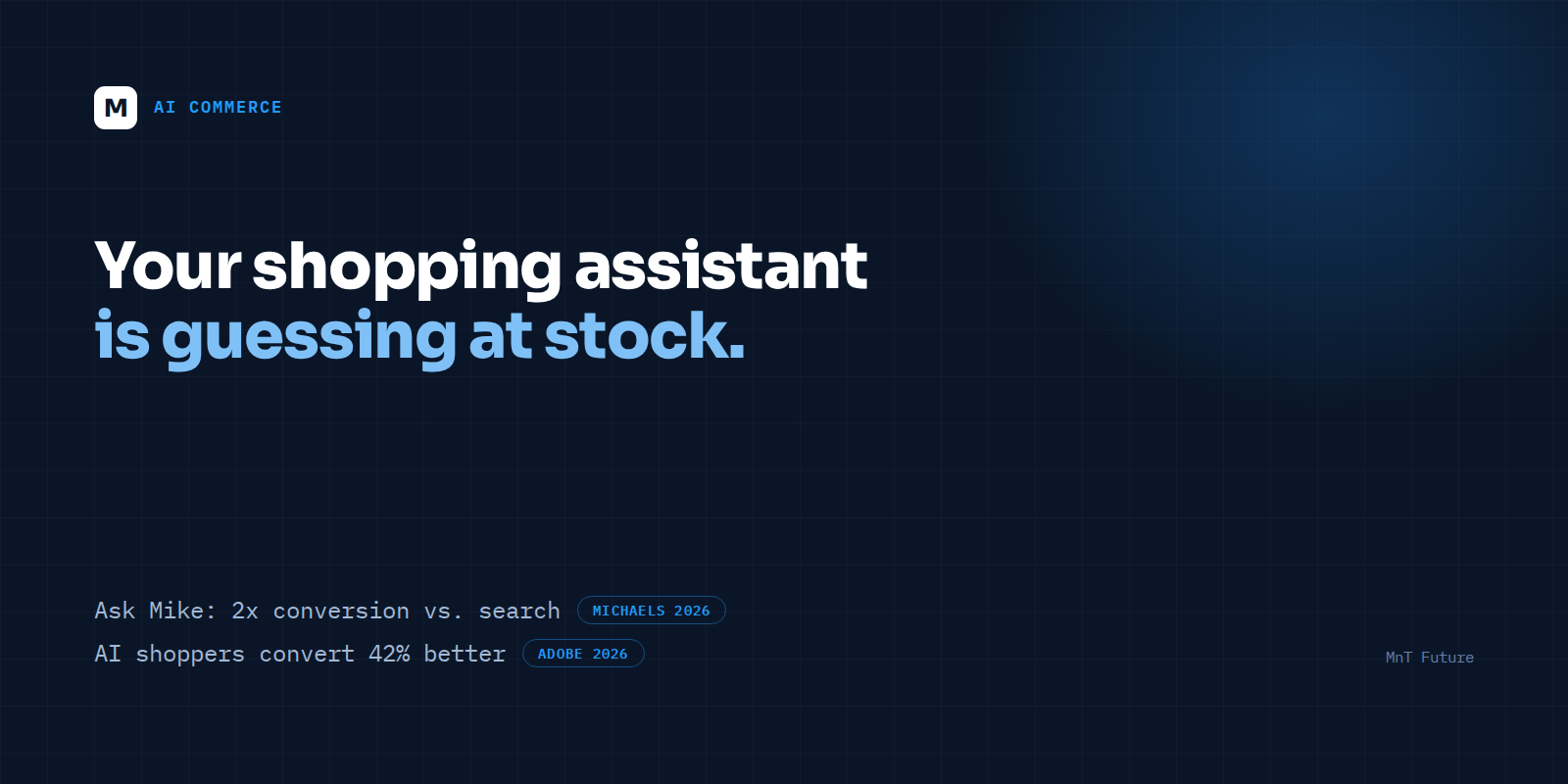
Adobe Digital Insights' Q1 2026 report, published June 24, 2026 and drawn from more than one trillion visits across 130-plus North American retailers, found that AI-referred traffic converted 42% better than non-AI traffic, spent 48% longer on-site, and drove 37% more revenue per visit — with orders carrying a 14% higher average order value on Shopify specifically. More than half of those AI sessions land directly on a product detail page, versus roughly 20% for organic search.
In other words: the traffic arriving from AI search and shopping agents is unusually ready to convert. The assistant sitting on your site is often the thing that talks them out of it.
Most shopping assistants are trained on the wrong layer
The common build pattern looks reasonable on paper: point a language model at your FAQ page, your return policy, a product-description export, maybe a PDF catalog, and call it a shopping assistant. It answers policy questions fluently. Then a shopper asks something that depends on data that changes hourly — stock level, price, promotion eligibility, ship date — and the assistant either hallucinates an answer from stale training data or deflects to "please check the product page," which defeats the point of asking at all.
The pattern holds across the category: assistants built on static content recommend items that are already out of stock, quote the wrong price, or guess at specs the source document never actually listed. None of that is a model-quality issue. It's an architecture issue — the assistant was never given a live read path into the systems that actually know the answer.
What "live" requires that a content sync job doesn't
Fixing this isn't a bigger knowledge base or a nightly re-index. It requires the assistant to query, at the moment of the question, the same systems your storefront checkout already trusts:
Real-time inventory and variant data. Stock by SKU, size, and location, queried live — not a batch export from last night.
Live pricing and promotion logic. Including anything time-boxed or segment-specific, so the assistant never quotes a price the cart won't honor.
Fulfillment and shipping truth. Ship-by and arrive-by dates computed from current carrier and warehouse data, not a static "3-5 business days" line copied from the FAQ.
Grounding with guardrails. The model should be constrained to answer only from what the live query returns — with an explicit "I don't have that yet" path — rather than filling gaps from its own training data.
Proof this is fixable, and what it's worth when fixed
Michaels gave a concrete look at what happens when the assistant is actually wired into the product layer. Its "Ask Mike" assistant, built on Google Cloud's Gemini Enterprise and launched in May 2026, had handled close to 75,000 conversations by the time Michaels reported results on July 28, 2026 — with a conversion rate more than double that of traditional on-site search, and 27% of interactions ending in a product click or cart addition. "Ask Mike acts as a creative assistant that helps shoppers move seamlessly from inspiration to product discovery and cart action," said Heather Bennett, Michaels' president and chief customer officer.
That result lines up with the broader pattern: conversational AI that's actually grounded in product data converts meaningfully better than a generic chatbot layer — the gap shows up specifically at the moment a shopper asks something the assistant can only answer correctly if it can see the live catalog.
The fix is sequencing, not a bigger model
Brands that get this right build the data layer before the conversation layer: a live catalog/inventory/pricing API the assistant queries in real time, grounding rules that stop it from guessing when that query comes back empty, and measurement tied to cart-adds and completed orders — not just chat volume. Brands that skip straight to "add a chatbot" end up with something that sounds helpful and quietly loses the sale on the one question that mattered.
This is the same data layer that makes a catalog usable by outside AI shopping agents, too — the structured, real-time product truth an AI search, recommendations, and shopping assistant build needs is identical to what an external agent needs under ACP or Google UCP. MnT Commerce, our own commerce platform, runs exactly this pattern in production: live inventory and pricing behind its own shopping assistant, not a static FAQ layer.
Why do AI shopping assistants get stock and price wrong?
AI shopping assistants give wrong stock or price answers because most are trained on static content — FAQs, PDFs, product descriptions — instead of querying live inventory and pricing systems in real time. The fix is architectural: connect the assistant to the same real-time catalog data your checkout already trusts, with guardrails that stop it from guessing when that data is unavailable.
Ready to see where your own shopping assistant — or your case for building one — actually stands? We run a free agent-readiness audit for US D2C and marketplace brands: what your current setup gets right, where it's answering from stale content instead of live data, and what it would take to fix.