
AI Shopping Assistants Convert 154% Better. Yours Doesn't.
Sometime in the past year, your store probably got an AI chat bubble in the corner. Most D2C brands added one — to handle "where's my order," sizing questions, and return requests without tying up a support inbox. That's a real, measurable win. It is also, according to the newest conversational-commerce data, not where the actual conversion lift lives.
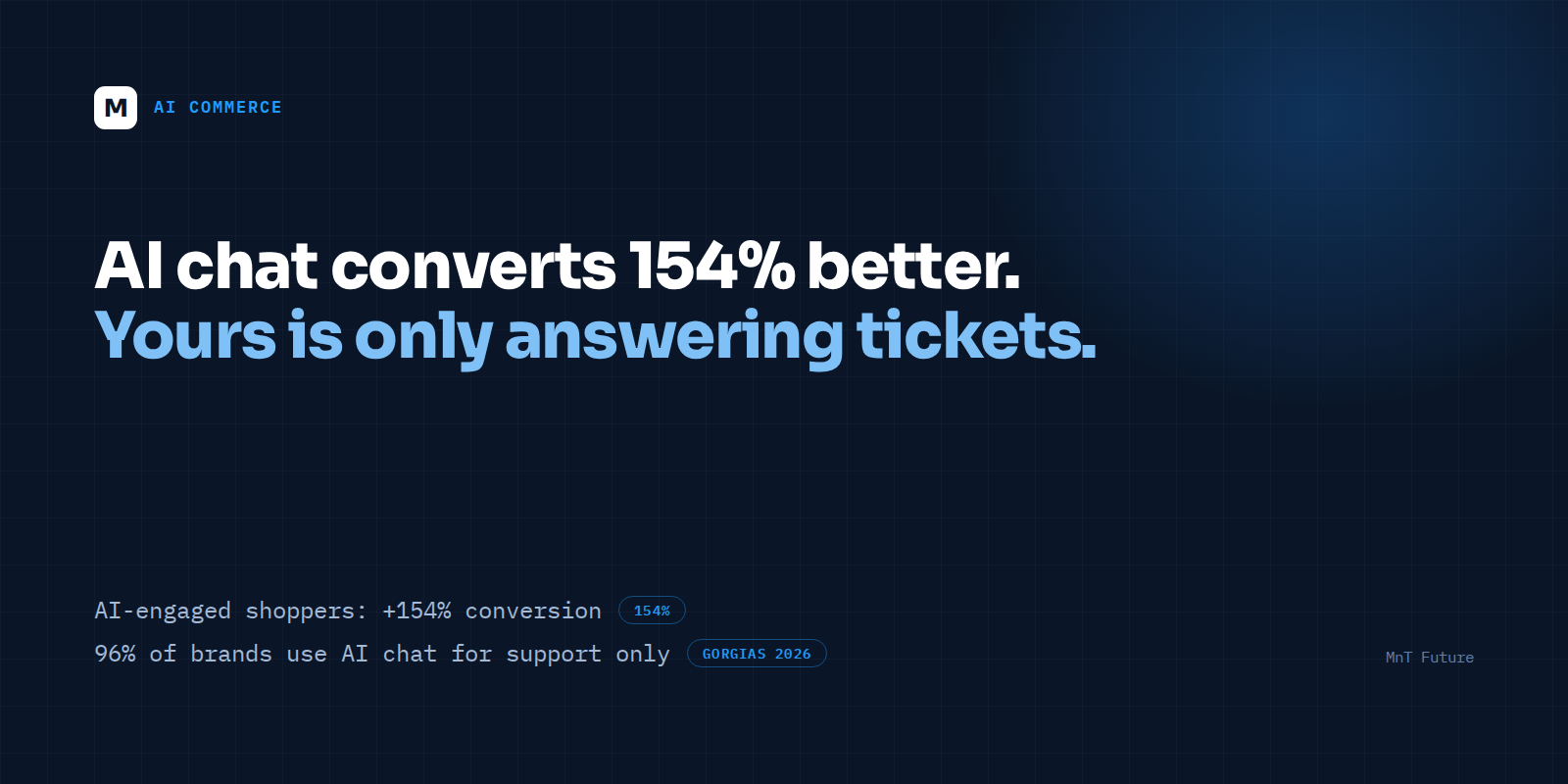
Gorgias's State of Conversational Commerce in 2026 Trends Report, covered by Retail Dive on February 3, 2026, found that shoppers who engaged in an AI conversation converted 154% better than shoppers who didn't. Ninety-three percent of purchases that followed an AI product recommendation happened within 48 hours of that recommendation. Seventy-nine percent of brands running AI-driven conversational commerce reported it increased sales and conversions directly. That's not a modest optimization. That's a different revenue channel hiding inside a tool most brands installed for cost savings.
Quick answer: AI shopping assistants that proactively recommend products convert up to 154% better than passive browsing, with 93% of AI-recommended purchases closing within 48 hours — but that lift requires an assistant grounded in live catalog and inventory data, not a support chatbot repurposed to also mention products.
Here's the gap most brands haven't closed yet. Triple Whale's 2026 roundup of ecommerce AI statistics, citing NVIDIA's 2026 State of AI in Retail and CPG survey, notes that among brands already running conversational AI, 96% use it for customer support. Support is the default deployment. Proactive, revenue-driving recommendation is still the exception — which is exactly why the 154% figure hasn't shown up in most brands' own numbers yet.
Why "Add a Chat Widget" Doesn't Get You the 154%
A support bot and a shopping assistant look similar from the outside — both live in a chat window, both respond in natural language. The gap between them is architectural, not cosmetic, and it's the reason bolting a general-purpose AI chat tool onto a storefront usually caps out at deflecting tickets instead of driving revenue.
A support bot needs a knowledge base: return policy, shipping windows, size charts, FAQ. Static content, updated occasionally, answered reactively when a shopper asks. A shopping assistant needs something structurally different — live grounding in your actual product catalog, so it can reason about attributes, not just retrieve pre-written answers. It needs real-time inventory and price awareness, so it never confidently recommends a size that sold out an hour ago. It needs a personalization layer that reads session behavior and purchase history, so the third recommendation in a conversation is sharper than the first. And it needs to act proactively — surfacing a recommendation at the moment a shopper is comparing two products or drifting toward exit, not waiting to be asked a direct question.
Miss any one of those pieces and you still have a chat widget. Get all four working together and you have the system behind the 154% number — an assistant that behaves less like a FAQ page and more like a good salesperson who happens to know your entire inventory in real time.
Picture the difference in a single session. A shopper lands on a jacket product page, opens the chat widget, and asks about return policy. A support bot answers correctly and the conversation ends there — useful, but it never touches the purchase decision. A shopping assistant grounded in live catalog and inventory data notices the same shopper has viewed two similar jackets in the last ten minutes, sees that the one they're currently viewing is low on stock in their likely size, and proactively surfaces that detail along with a comparable in-stock option. One of those conversations resolves a question. The other one closes a sale, or at minimum removes the single biggest reason carts get abandoned: uncertainty at the moment of decision.
What This Means for Your Roadmap
The useful next step isn't "buy an AI chat tool" — most brands already have one. It's auditing what the one you have is actually doing. If it's resolving support tickets and nothing more, it's doing its job, but it isn't the system this data is describing. If it occasionally surfaces a product link when directly asked, it's closer, but it's still reactive rather than proactive, and reactive is where most of that 154% gets left on the table.
Getting to a true shopping assistant is a data and architecture problem before it's a model problem: your product catalog needs to be structured well enough for an AI system to reason over it, your inventory and pricing systems need to expose real-time state to that reasoning layer, and the assistant needs a way to act inside the shopping session — not just answer questions at its edge.
This is also where the AI search and recommendation layer connects to the checkout experience your custom or headless storefront build is already handling. A shopping assistant that recommends well but hands the shopper back to a slow or confusing checkout leaves conversion on the table at the next step instead of this one.
There's a second reason to get the on-site assistant right now, beyond this quarter's conversion number. The same grounding work — a structured, semantically searchable product catalog with real-time inventory and pricing — is the foundation an external AI agent needs to discover and transact with your store under standards like ACP and Google UCP. Brands treating their on-site shopping assistant and their external agent-readiness as two separate projects are usually rebuilding the same data layer twice. Brands treating it as one project get the 154% lift on-site now, and a head start on being transactable by outside agents as that shift accelerates through 2026.
We build this layer as part of agent-ready commerce for US D2C and marketplace brands — AI search, recommendations, and shopping assistants engineered against your live catalog and inventory, not a generic chatbot skin. MnT Commerce, our own internal platform, runs this exact combination: semantic search, a shopping assistant, and an operations agent working off the same real-time data. If you want a straight read on where your current chat deployment actually sits — support-only, semi-proactive, or genuinely revenue-driving — a free agent-readiness audit will tell you in under an hour, with no obligation attached.