
AI Shopping Agents Read Feeds, Not Product Pages
Your product pages rank well. Your on-site search works fine. Your Core Web Vitals are clean. And yet when a shopper asks ChatGPT, Perplexity, or Amazon's Rufus to find a product like yours, your brand doesn't show up — a competitor with a noticeably worse website does.
That's not a fluke, and it isn't an SEO problem in the traditional sense. It's a data problem. AI shopping agents increasingly pull what they show shoppers from structured product feeds, not by crawling and reading product pages the way Googlebot does. If your feed is thin, stale, or missing fields, you can rank first organically and still be invisible to the AI agent now standing between you and the sale.
Feeds Are Beating Pages, and the Gap Is Widening
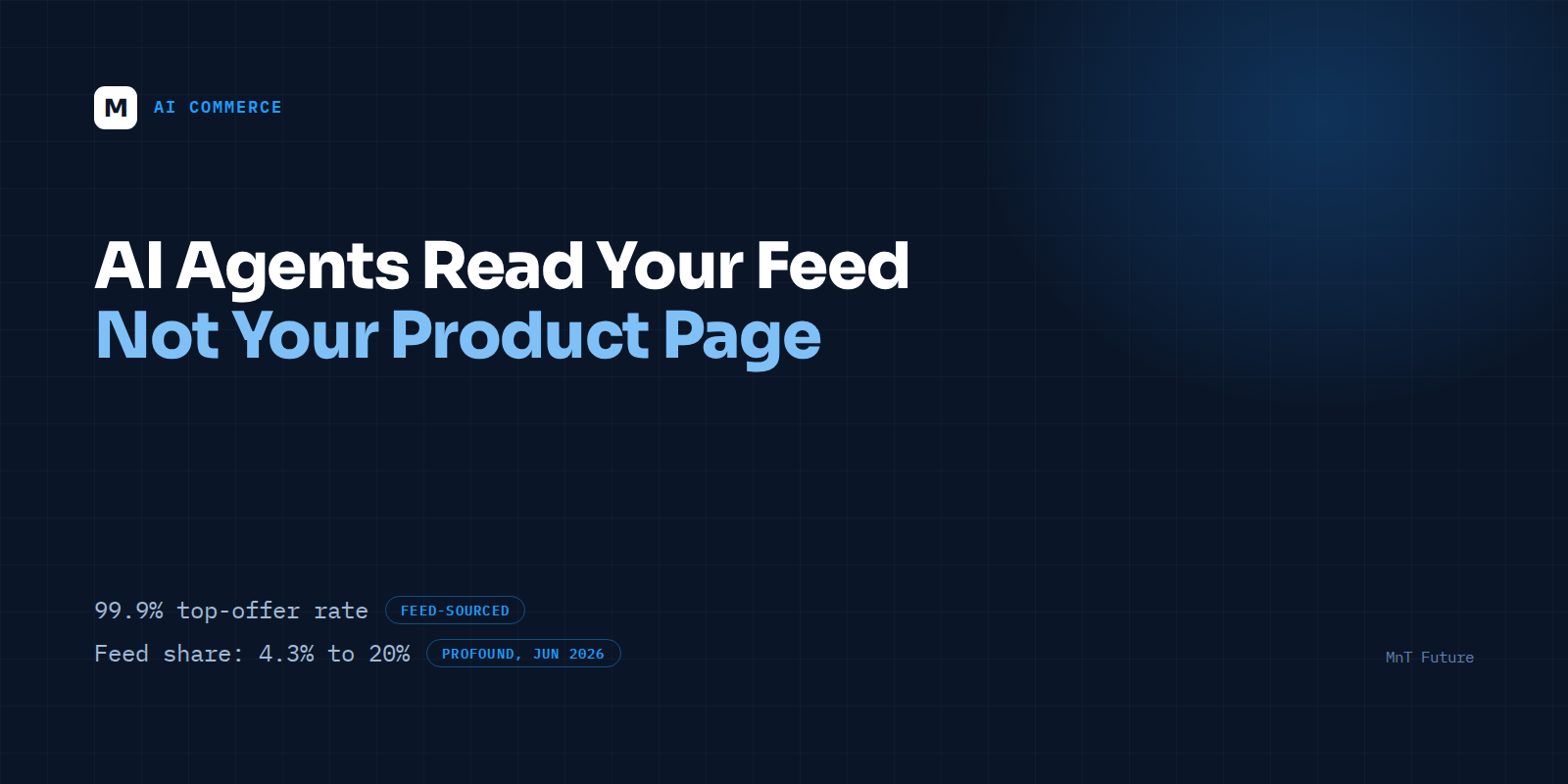
A June 2026 analysis by Profound, covered by Search Engine Land at the end of July, put a number on what a lot of merchants had started to suspect: products sourced from a structured feed appeared as a top offer in ChatGPT's shopping results 99.9% of the time, arriving with complete brand, image, and merchant data attached. Products pulled by scraping a product page carried none of that structured completeness. Over the same window, the share of ChatGPT shopping retrievals coming from feeds rather than pages jumped from 4.3% to 20% in six weeks.
The reverse finding matters just as much: roughly 88% of the offers ChatGPT actually shows shoppers today still trace back to product detail pages, not feeds. That isn't a contradiction — it means the feed decides whether a product gets considered and ranked as a top offer, while the page still does real work once a shopper clicks through. Brands optimizing only one side of that pair are leaving the other exposed.
Every Agent Wants a Different Diet
There's no single "AI shopping feed" to build once, and that's the part most marketing teams miss. Perplexity's shopping surface leans on external citations and reviews as much as on catalog data — shoppers who arrive through a cited product page spend meaningfully more per order than the site average, according to Perplexity's own merchant reporting. Amazon's Rufus, now used by a large share of Amazon's mobile shoppers, wants attribute-level specificity — size, material, compatibility — because that's what it quotes back to the shopper mid-conversation. Google's AI Overviews and Gemini pull from Merchant Center feeds enriched with newer conversational attributes Google has been rolling out this year: structured Q&A pairs, related-product fields, popularity signals. Microsoft's Copilot weighs price competitiveness heavily enough that shopping placements inside it see a meaningfully higher click-through rate than other channels.
Build one feed for all of them and you'll satisfy none of them well. Build for the two or three engines where your buyers actually are, and structure the rest to degrade gracefully rather than break.
Why Your SEO Team Can't Fix This Alone
Here's the uncomfortable part for a lot of marketing teams: traditional organic ranking and AI shopping visibility have decoupled. Industry tracking published in July 2026 found only a low single-digit percentage of AI Mode advertisers also ranked organically for the same terms — the overwhelming majority of AI-visible listings weren't organic top performers at all. Feed structure, GTIN accuracy, price freshness, and live availability status now carry weight that used to belong almost entirely to on-page content and backlinks.
That's a data-pipeline and engineering problem as much as a content one. Someone has to own GTIN coverage across the full catalog (not just bestsellers), real-time price and inventory sync into the feed, and the mapping between your PIM or ERP and each channel's required schema — and it has to stay correct every day, not just on launch day.
What an AI-Ready Feed Actually Requires
A feed built for AI shopping agents, not just Google Shopping ads, needs a few things most catalogs are missing today: complete, valid GTINs on every SKU, not only the top sellers; real-time price and availability sync, not a nightly batch job that goes stale by afternoon; rich attributes — material, fit, compatibility, use case — structured as their own fields, not buried in a description paragraph an agent has to parse; the newer conversational fields platforms are adding, such as Q&A pairs, related products, and review or popularity signals; and a monitoring layer that flags feed rejections and incomplete fields before they cost a placement, not weeks after.
This is exactly the layer MnT Future builds when we take a D2C brand agent-ready: not a rewrite of every product page, but the data-pipeline work — PIM-to-feed mapping, real-time sync, per-channel attribute structuring — that decides whether ChatGPT, Rufus, or Gemini can see a brand as a legitimate top offer at all. It's the same discipline behind agent-readiness for ACP, Google's UCP, and Retail MCP: the agent doesn't read a site the way a person does, so the underlying commerce platform has to be built for a reader that only trusts structured data.
The Fix Starts With Knowing Where You Stand
If you don't know whether your product feed is structured the way ChatGPT Shopping, Rufus, or Gemini actually need it, that's the first thing worth finding out — before spending another quarter polishing pages an AI agent will never crawl.
AI shopping agents like ChatGPT Shopping, Amazon Rufus, and Perplexity primarily source product listings from structured product feeds, such as Google Merchant Center, not by crawling product pages. Feed-sourced listings appear as top offers far more reliably than page-scraped ones, so brands with incomplete or stale feeds are largely invisible to AI shoppers.
MnT Future offers a free agent-readiness audit that checks exactly this: feed completeness, per-channel attribute coverage, and where a brand is losing placements to a competitor with a messier site but a cleaner feed. See how agent-ready commerce works, look at proof from builds like Searchlight and MnT Commerce, or book a free strategy session to see exactly where your store stands with the agents now doing the shopping for your customers.