
Why AI Shoppers Bounce at Your On-Site Search Box
A shopper asks ChatGPT for "a waterproof running jacket under $150 that packs down small," gets three options, and clicks through to one of the brands. They land already sold on the category, the price range, and the use case. By every normal measure, that shopper should convert easily.
Increasingly, they do — right up until they hit the brand's own search box.
Quick answer: AI-referred shoppers now convert better than any other traffic source because assistants like ChatGPT and Perplexity do the research phase for them before they ever land on a site. But most on-site search still matches keywords, not intent — so a shopper who just spoke a full sentence to an AI gets a zero-results page when they type that same sentence into the brand's own search bar.
The AI traffic paradox
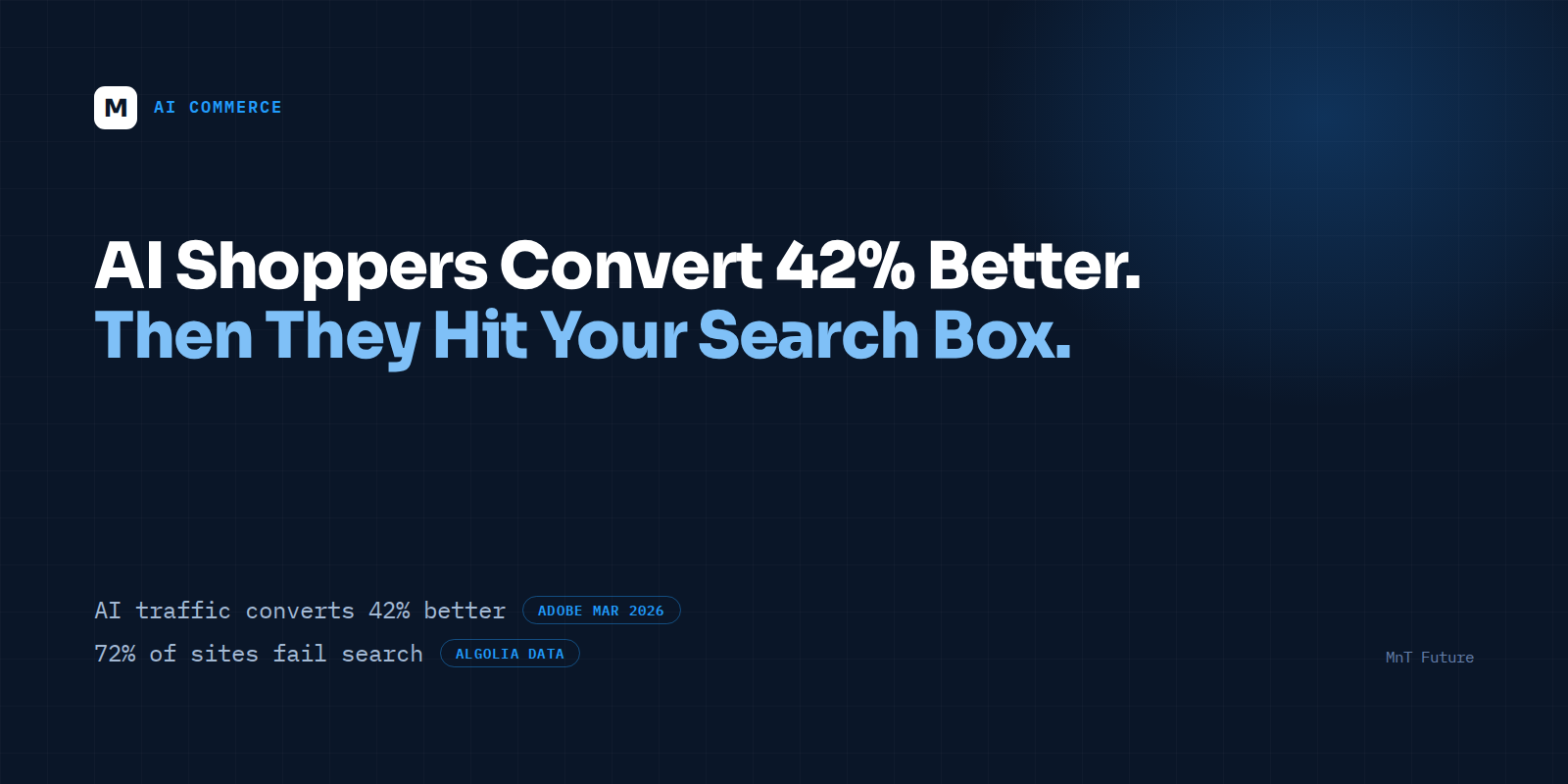
In March 2026, Adobe Digital Insights measured AI-referred retail traffic converting 42% better than non-AI traffic — an 80-percentage-point swing from March 2025, when the same channel converted 38% worse than average. The same visitors spent 48% more time on-site, viewed 13% more pages, and generated 37% more revenue per visit than non-AI traffic. Adobe also logged 393% year-over-year growth in AI-referred traffic volume for Q1 2026 (via Digital Commerce 360, April 23, 2026).
Shopify's independently sourced merchant data pointed the same direction in May 2026: AI-referred sessions converting at nearly 50% higher rates than organic search on product detail pages, with 14% higher average order values and 8x year-over-year session growth.
The mechanism isn't mysterious. An AI assistant compresses the browsing-and-comparing phase into a single conversation. The shopper who lands on a brand's site from that conversation isn't "traffic" in the old sense — they're a pre-qualified buyer who already knows what they want.
Where the advantage dies: the brand's own search box
Site search has always been a conversion multiplier when it works. Algolia's compiled ecommerce benchmarks show Amazon's conversion rate jumping 6x (2% to 12%) when a visitor searches instead of browses. Walmart sees roughly 2.4x. Etsy sees around 3x. Across the wider market, shoppers who use site search convert at 4.63% against a site average of 2.77% — 1.8x better.
The problem is that most search implementations still don't work. The same benchmark data puts the failure rate at 72% of sites falling short of baseline search expectations, and 41% failing to support the kinds of queries — natural language, synonyms, misspellings, combined attributes — that shoppers now type without thinking twice.
That gap used to be a nuisance. It's becoming a leak. A shopper who just described "a waterproof running jacket under $150 that packs down small" to an AI assistant types the same sentence into the site's own search bar out of habit. A keyword-matching engine parses that as six unrelated tokens, returns nothing useful, and the shopper — who has just been trained by an assistant that understood every word — doesn't retype it in SKU-speak. They bounce, often straight back to the AI answer that sent them there in the first place.
What agent-ready, on-site search actually requires
Fixing this isn't a copy problem or a UI problem. It requires a semantic layer between the search box and the product catalog: intent parsing that extracts price ceilings, use cases, and size or material constraints from a full sentence; ranking by relevance instead of exact string match; and a fallback that offers close alternatives instead of a blank results page.
Three checks tell a brand roughly where it stands today. First, pull the last 90 days of on-site search logs and isolate queries that returned zero results — that list is the plainest evidence of the gap between how shoppers now type and what the search engine can parse. Second, run five or six full-sentence queries a real shopper might use — "gift for someone who runs in the rain," "something for a beach wedding under $100" — and check whether the results are relevant or just keyword-adjacent noise. Third, check what happens on a zero-results page: a blank screen with a "try again" prompt loses the shopper on the spot, while a fallback that surfaces close alternatives keeps them in the funnel even when the exact query doesn't map to an exact product.
It's also worth building this as the same layer that makes a catalog agent-ready for ACP, Google UCP, and Retail MCP — because an AI shopping agent querying a product feed on a customer's behalf needs the identical structured, intent-mapped product data that a human typing a full sentence into a search bar needs. Brands solving the on-site search problem are most of the way to solving the agent-readiness problem, and vice versa. Treating them as two separate projects usually means paying for the semantic layer twice.
We rebuilt our own search before we sold anyone else's
MnT Commerce, our own AI-native commerce platform, runs semantic search and a shopping assistant against our own catalog — not a client project, our own dogfooded build. It's the reference implementation we point to when a brand asks what "agent-ready search" actually looks like in production, because we run it ourselves before we recommend it to anyone else.
The traffic shift is already measurable and already in your analytics. The fix — a semantic search and recommendation layer that understands a full sentence the way the AI assistant that sent the shopper did — is smaller than most teams assume, and it pays for itself on the traffic you're already paying to earn.
If you want a clear read on where your own search and product data currently stand, we run a free agent-readiness audit that checks exactly this — how your on-site search, product feed, and catalog structure would perform against both AI shoppers and the assistants sending them to you.