
AI Overview Citations: Why Ranking #1 Isn't Enough
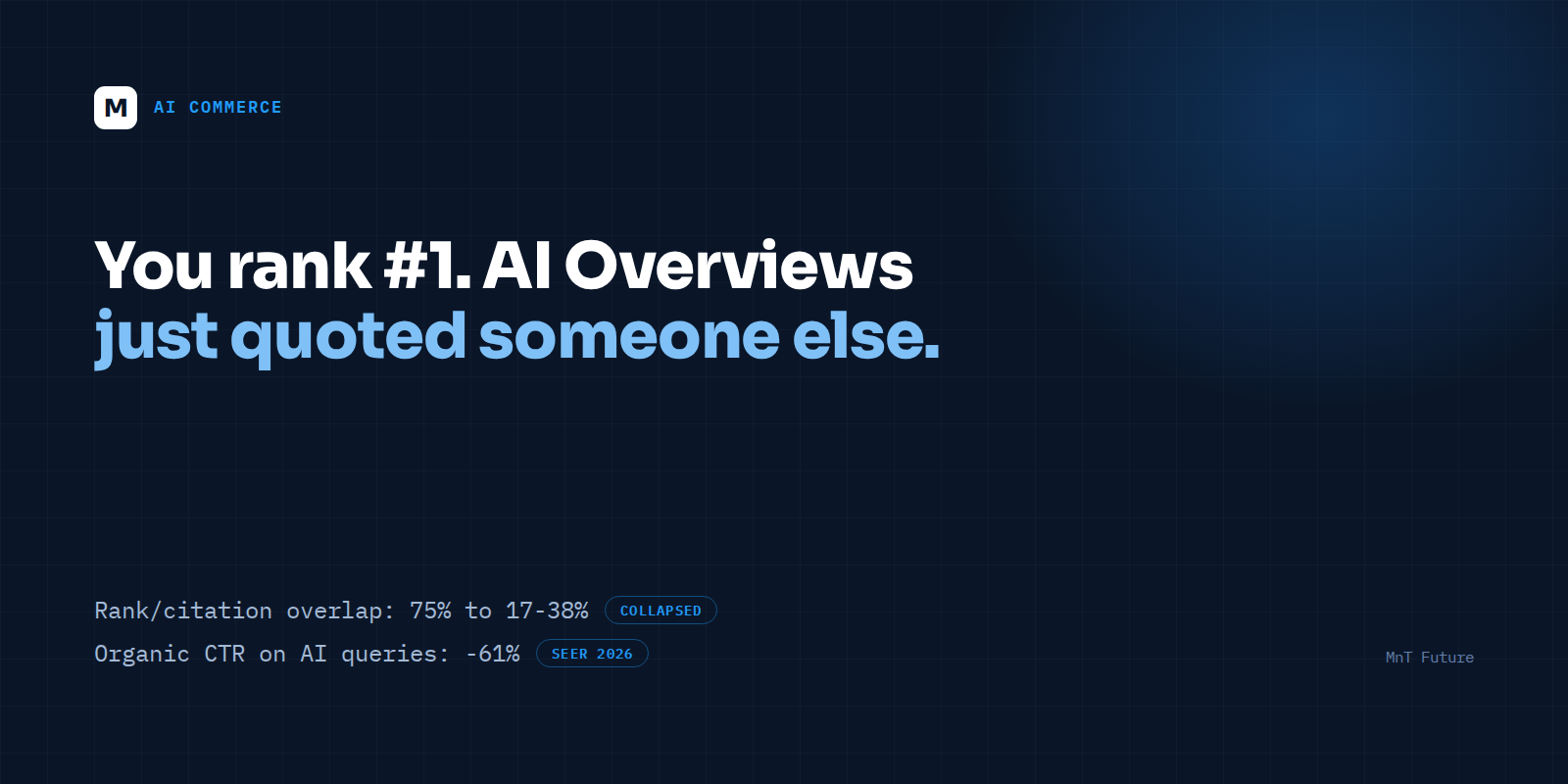
A product page ranking #1 on Google for its exact keyword used to be the safest bet in ecommerce marketing. Rank well, get clicked, get bought. In 2026 that chain has a broken link in the middle, and the gap between "ranks well" and "gets cited" is now wide enough to swallow a quarter's worth of organic traffic.
The Rule That Broke
Seer Interactive tracked 3,119 queries across 42 organizations between June 2024 and September 2025. On queries that triggered an AI Overview, organic click-through rate fell from 1.76% to 0.61%, a 61% decline. Even queries with no AI Overview saw CTR drop 41% market-wide, because searcher habits are shifting across the board, not only on AI-heavy queries.
The more important number sits underneath that one. Being in the top 10 organic results used to be a reliable proxy for AI Overview inclusion, with roughly 75% of AI Overview citations pulled from top-10 pages in mid-2025. By early 2026 that overlap had collapsed to somewhere between 17% and 38%, according to Search Engine Land's analysis with Graphite. Ranking well and getting cited by Google's AI are no longer the same fight, and a brand can win one while quietly losing the other.
Does ranking #1 guarantee an AI Overview citation in 2026?
No. Top-10 organic ranking now correlates with AI Overview citation only 17-38% of the time, down from roughly 75% in mid-2025. Google's AI increasingly cites pages for structured clarity and entity relevance rather than keyword ranking alone, which means a separate citation strategy, not just better SEO, is now required to stay visible.
Why This Lands Hardest on Product Pages
ALM Corp's tracking shows organic click share down 11 to 23 percentage points across verticals between January 2025 and January 2026, with product-research categories among the steepest declines. Roughly 60% of Google searches now end without a click at all, a figure that climbs past 90% inside AI Mode.
Translate that into an actual shopping moment. A buyer searching "best running shoes for flat feet" or "is retinol or vitamin C better for sensitive skin" is doing exactly the comparison research that used to land on a brand's product or category page. Increasingly, that research happens entirely inside Google's answer box. A brand's #1-ranked page can sit untouched below the fold while the AI Overview answers the question using someone else's content, or a synthesized answer that credits no one at all.
For a funded D2C brand spending real budget on SEO and content, this isn't a ranking problem that more backlinks will fix. It's a visibility problem sitting one layer removed from ranking, and most teams don't have a dashboard for it yet.
The Measurement Trap: You Can't Fix What You Can't See
Most analytics setups still measure organic performance the old way: sessions, rank position, click-through rate by keyword. Almost none of them segment out how often a brand's own pages get cited inside an AI Overview versus simply ranking near one. When traffic on a product category softens, teams reach for the usual explanations — seasonality, a core update, a competitor promotion — and rarely for the actual cause: the page still ranks fine, it just stopped being the page Google's AI chooses to quote.
That blind spot is the first thing worth closing, because a brand cannot prioritize a citation-optimization sprint against a number it has never tracked.
What Actually Gets Cited Isn't Always What Gets Ranked
Classic ranking signals reward links, relevance, and authority accumulated over time. AI Overview citation rewards something adjacent but distinct: extractable clarity. Pages that state a direct answer near the top, define their entities plainly (product name, category, key specifications, direct comparisons against alternatives), and carry structured data that removes any ambiguity about what the page is actually about tend to win the citation even when a competitor outranks them.
This is the same machine-readability gap that shows up when an AI shopping agent crawls a product page and can't tell a bundle from a single unit, or a subscription price from a one-time price. Ranking algorithms and AI citation systems are reading the same page for different signals, and a page engineered for only one of them no longer automatically wins the other.
Where This Is Heading for US D2C Brands
MnT Future treats AI-citation visibility as its own engineering and content layer, sitting alongside traditional SEO rather than replacing it. In practice that means structured product data (Product, Offer, and FAQPage schema implemented correctly, not just present in a template), on-page answers written so they can be lifted whole into an AI response, and a monitoring habit that tracks citation rate with the same discipline a team already applies to keyword rank — the same discipline behind taking our own accessibility audit work and AI Cleanup Lab to a measured before-and-after rather than a one-time checklist.
It's also the same foundational layer that agentic commerce needs. The structured entity data that earns an AI Overview citation is close to identical to what an AI shopping agent needs to read a product page correctly under the Agentic Commerce Protocol, Google's Universal Commerce Protocol, or a Retail MCP server. Brands building this layer now for AI search visibility are, without extra effort, also building their agent-readiness for the checkout layer that comes next — the same verification discipline behind Searchlight, our own SEO/AEO agent that checks its own citation and ranking work rather than assuming it landed.
What To Do About It This Quarter
Three moves are worth making before the next content sprint, not after it. Audit the twenty highest-traffic product and category pages for whether they answer their core question in the first two sentences, in plain language, ahead of any brand framing. Check whether Product, Offer, and FAQPage schema is actually present and valid on those pages, tested rather than assumed. And start tracking AI Overview citation rate for the top query set the same way rank position gets tracked today, because a metric nobody watches is a metric nobody improves.
None of this replaces the SEO work already underway. It sits next to it, and increasingly it is the difference between a page that ranks well and a page that actually gets seen by the shopper doing the deciding.
If it would help to see exactly where your own product pages stand, MnT Future's free agent-readiness audit checks structured data, citation readiness, and how discoverable a store already is to both AI search and AI shopping agents. It's a focused thirty-minute look, not a sales pitch, and it names specifically what is costing visibility right now, and what to fix first.