
AI Didn't Cut Your Dev Bill. It Moved It.
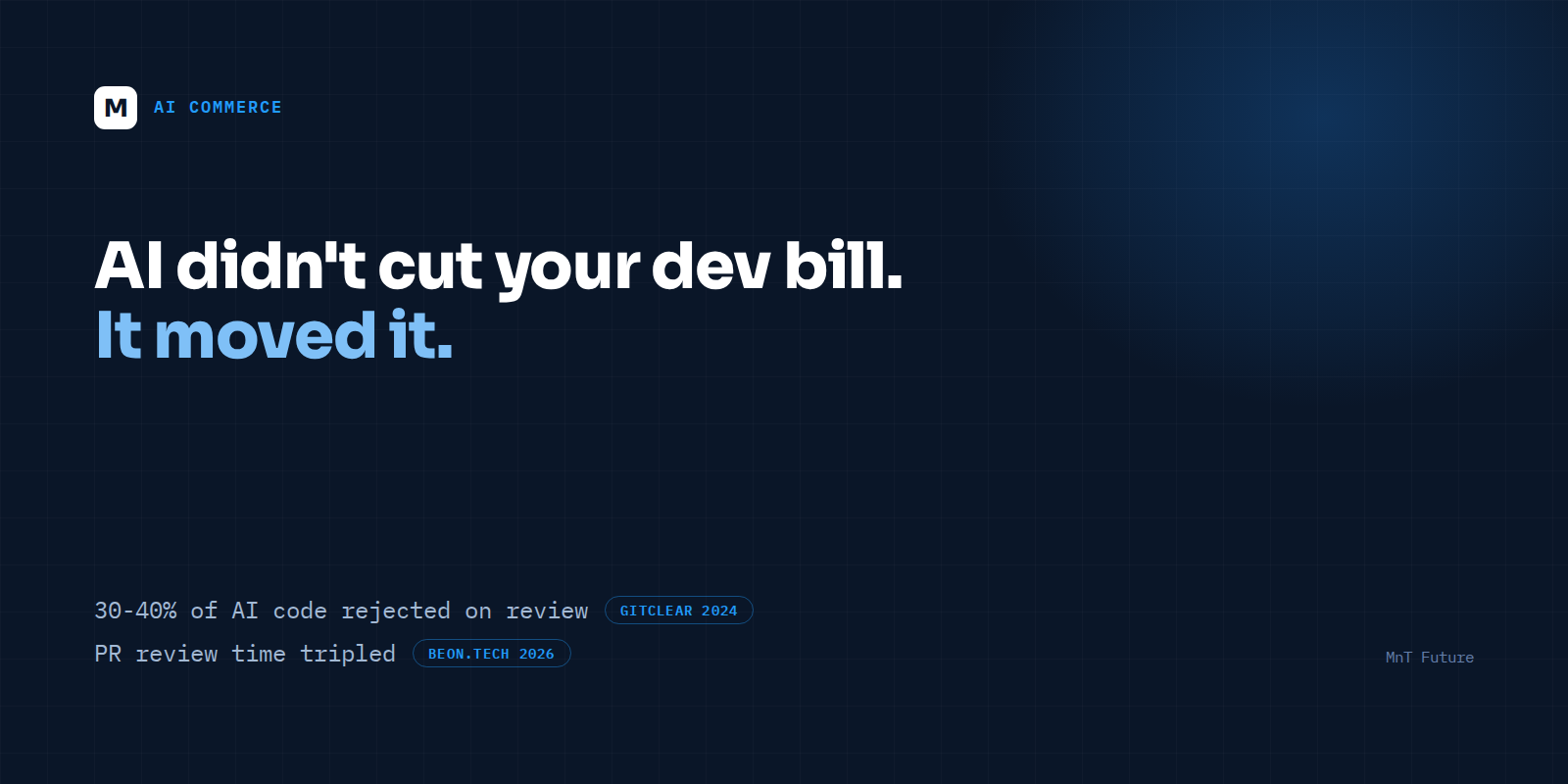
If you've talked to more than one commerce-platform vendor in 2026, you've heard some version of the same pitch: AI coding tools mean faster builds at a lower price, because the AI is now doing work that used to cost a senior developer's hourly rate. The pitch is half right. AI tools genuinely write a meaningful share of production code today. What the pitch usually leaves out is where the rest of that cost went.
How Much Code AI Actually Writes Now
The numbers are real, and they're bigger than most buyers assume. Satya Nadella said at LlamaCon in April 2025 that 20 to 30 percent of the code inside Microsoft's own repositories is now AI-generated. Sundar Pichai told investors on Google's Q3 2024 earnings call that roughly 30 percent of new code at Google is AI-written. GitHub's own 2024 research found that in repositories with Copilot enabled, up to 46 percent of the code developers accepted came from the suggestion engine rather than from typing it themselves.
Those are the numbers every "AI makes us faster and cheaper" pitch leads with. Here's the part it usually skips.
Quick answer: AI now writes 20-30%+ of production code at Microsoft and Google, but that hasn't cut engineering cost — it moved it. GitClear found 30-40% of AI-generated code gets rejected on first review, and one 2026 report cites a founder whose PR review time tripled. The cost shifted from writing code to reviewing it, and only senior engineers can absorb that safely.
The Part the Pitch Skips: Review Didn't Get Cheaper
GitClear's 2024 analysis, compiled in Second Talent's 2026 review of AI-coding statistics, found that after Copilot adoption, code churn — code rewritten or deleted shortly after being written — doubled, duplication increased, and 30 to 40 percent of AI-generated code was rejected on its first review pass. Separately, BEON.tech's 2026 talent-market report quotes a founder putting the practical result plainly: "Our PR review time tripled this year."
That's not a story about AI writing categorically worse code. A separate IEEE study found Copilot-generated code carried vulnerability rates roughly equivalent to human-written code — a more honest finding than the "AI code is always buggier" line some vendors reach for. The real pattern is narrower and, for a commerce brand, more useful: AI writes code fast enough that review volume exploded, while Stack Overflow's 2024 developer survey found only 43 percent of developers trust AI output "highly" or "very highly." The other 57 percent are, correctly, treating most AI-authored pull requests as something that needs a real second look.
Higher volume plus limited trust adds up to more review hours, not fewer. That review capacity is exactly what a lot of commerce vendors under-resourced when they built their AI-tooling pitch around speed alone.
Why the Junior-Heavy Offshore Model Breaks Here
The classic offshore commerce-build pitch pairs junior developers with AI copilots and sells the combination as fast and cheap. But if AI-generated code needs more senior review hours per line rather than fewer, a team that's junior-heavy on the review side can't keep up. Code volume rises, the review bottleneck doesn't move, and whatever the junior reviewer didn't catch ships anyway.
Where that gap lands depends on what's being reviewed. On a marketing page, an unreviewed edge case is a minor bug. On a checkout flow, a split-payment ledger, or stored customer payment data, it's a security or compliance incident. PCI DSS v4.0.1's full requirement set — including the batch of requirements that were originally future-dated — became mandatory on March 31, 2025. There is no grace period left where "we'll review that later" is an acceptable answer for anything touching cardholder data.
The talent market isn't loosening to make this easier, either. BEON.tech's 2026 analysis describes a bifurcated US developer market: an oversupply of junior and generalist developers competing for fewer entry-level roles, alongside a senior shortage in AI/ML, cloud infrastructure, and cybersecurity that stayed persistently high even through the 260,000-plus tech layoffs across major US companies in 2023. The U.S. Bureau of Labor Statistics forecasts software developer employment growing 15 percent from 2024 to 2034 — twice the rate of the average U.S. occupation. Senior engineering hours are not the part of this equation getting cheaper.
What Senior-Only Delivery Actually Buys a Commerce Brand
None of this is an argument against AI tooling — it's an argument about who reviews what it produces. We use the same category of tools other engineering teams do, on the parts of a build that don't need a senior engineer examining every line. What doesn't change is who reviews the code that touches checkout, inventory, payments, and customer data before it ships: a senior engineer, every time, not whichever reviewer is fastest to close the ticket. That's the same discipline behind our senior-only commerce platform delivery, and it's the same discipline we've applied hardening stores that weren't built that way from day one, through our AI Cleanup Lab.
Here's the honest caveat: senior-only delivery costs more per hour than a junior-heavy offshore team. That's not in dispute. The claim isn't that it's cheaper — it's that the hour you're actually paying for, a senior engineer's review time, was never going to get cheaper once AI made everyone write more code. Paying for that review once beats paying for the breach, the chargeback dispute, or the compliance finding later.
The Question Worth Asking Any Vendor
Before signing with a commerce-platform vendor selling speed through AI, ask a narrower question: who reviews the AI-generated code that touches your checkout and your customers' data, and how senior are they? In 2026, that's where the real engineering cost — and the real risk — actually lives.
If you want a straight answer on where your own platform stands, start with a free agent-readiness audit or a free strategy session — we'll show you exactly what we'd review first.