
Why "We Use AI" Is the Wrong Agency Question in 2026
Every commerce platform RFP response this year says some version of "we build faster with AI." Cursor, Copilot, Claude Code — the tools are in the pitch deck, they're on the vendor's marketing page, and increasingly they're the whole selling point. If you're a US D2C or marketplace brand comparing agencies for a replatform, a marketplace build, or a B2B wholesale portal, you're being sold on speed. Almost nobody is showing you the number that actually predicts whether that speed produces a store that works.
That number is review time. And the 2026 engineering data on it should change the question you ask before you sign anything.
The Data: Throughput Went Up. Review Time Went Up Four Times Faster.
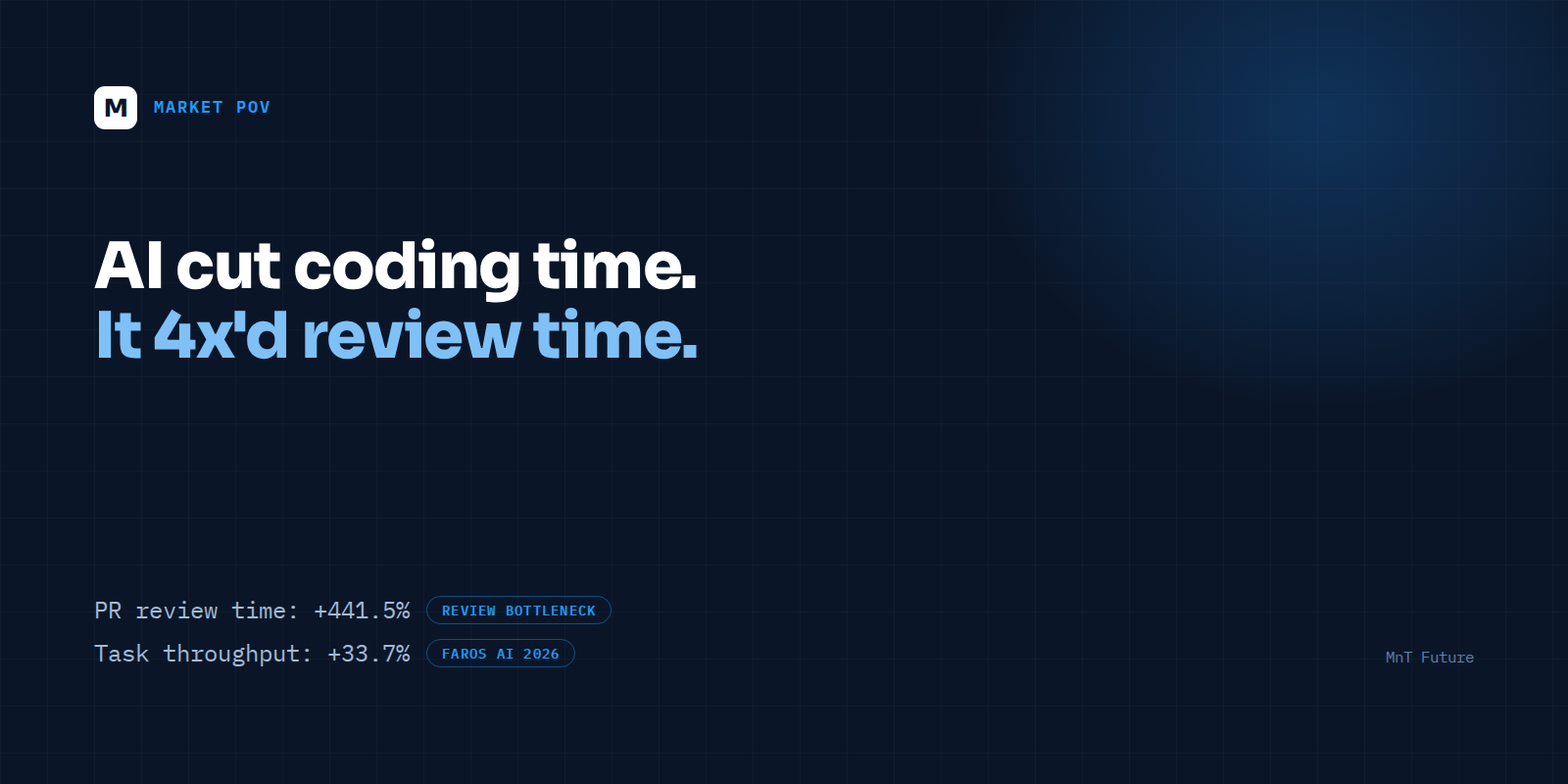
In April 2026, Faros AI published its "Acceleration Whiplash" report — two years of telemetry from 22,000 developers across more than 4,000 teams, one of the largest studies of its kind to date. The adoption side of the story is what every vendor pitch leads with: 80% of teams now have more than half their developers using AI coding tools weekly, AI suggestion acceptance rates climbed from 20% to 60%, and task throughput per developer rose 33.7%.
The part that doesn't make the pitch deck: median time spent in code review rose 441.5%. Code churn — code rewritten or reverted shortly after being written — rose 861%. Incidents per merged pull request rose 242.7%. Pull requests that merged with no review at all rose 31.3%.
Read those side by side. Throughput rose by a third. Review burden rose by more than four times over. The constraint didn't disappear when AI started writing more of the code — it moved. Writing code got cheap. Verifying it got expensive, and most engineering organizations haven't restructured around that yet.
What's the real bottleneck in AI-assisted software development in 2026?
It's no longer writing code — it's reviewing it. A 2026 study of 22,000 developers found PR review time up 441.5% and code churn up 861%, while AI raised task throughput by only 33.7%. Adding junior developers doesn't close that gap; it adds more AI-generated code needing review without adding anyone senior enough to review it.
Why the Offshore Scaling Playbook Breaks Exactly Here
The standard answer to "can you go faster" has been the same for twenty years: add developers. Add AI to that formula and the pitch gets more attractive on paper — more junior developers, each now producing more code per day with AI assistance, priced at offshore rates.
The Faros data says that's the wrong lever. The bottleneck isn't how much code gets written; it's how much code gets safely verified before it ships. A junior-heavy team with AI tools produces more code that needs senior-level review while adding fewer people actually capable of doing that review. Throughput and validation capacity move in opposite directions under that model, and the gap between them is where the 31.3% of unreviewed pull requests and the 242.7% jump in incidents-per-PR come from.
This is the same failure pattern that tends to surface later as a compliance or security problem on a live commerce platform — the code shipped fast, and the review that would have caught the issue never happened at the volume the tools now demand.
The Vendor Question That Actually Predicts Quality
"Do you use AI to build?" isn't a useful question anymore — every agency will say yes, and it tells you nothing about whether the output gets checked. The question that predicts what you'll actually get is narrower:
- What percentage of your pull requests merge without a senior engineer's review?
- What's your median time in code review, and how has it changed as your team adopted AI tools?
- Who reviews AI-generated code specifically — the same developer who prompted it, or someone else?
An agency that can answer those three questions with real numbers has a review process built for 2026. An agency that answers with "we use AI, so we're faster" hasn't measured the part that matters.
Where This Is Heading
The vendor-transparency conversation is already moving this direction at the enterprise level. Contract-clause guidance published this year for enterprise AI vendor agreements has started formalizing disclosure and verification rights — buyers retaining the right to audit or commission third-party review of a vendor's process, rather than taking their word for it. Code review practice is a natural next stop on that same trend: agencies that can show their review gate, not just claim one, will be the ones that win the harder RFPs.
How MnT Builds Against This
MnT Future ships 100% senior-engineer delivery — no juniors on client commerce platform work, by policy, not by exception. AI tools are part of how our team works; they are not a substitute for the review gate. Every pull request, whether a senior engineer wrote it from scratch or shaped it with AI assistance, goes through the same senior review before it ships. The tools changed how fast code gets written. They didn't change what has to happen before it goes live.
We won't tell you our review process eliminates bugs — no honest engineering team can claim that. What we can tell you is that the gate doesn't move when the tooling does, and that's the difference between a store that ships fast and a store that ships fast and still works six months later.
If you're mid-way through vetting a commerce platform partner, ask the three questions above before you ask about price. We'll answer them for MnT with real numbers — and we're glad to help you read anyone else's answers too. Start with a free agent-readiness audit or a free strategy session, and bring the RFP.