
AI Cleanup Audit: Real Before/After Numbers
You didn't write the code, so you can't tell if it's safe.
That's the position a lot of US D2C and marketplace teams are in right now. The storefront was built fast, mostly by prompting an AI tool, and it demoed beautifully. Nobody on staff reviewed the auth logic line by line, because nobody on staff wrote it. It works — until someone asks the question that matters more than "does it work": would this pass a security review, and would it survive a traffic spike?
The data says the odds are against you. Veracode tested code generated by more than 100 large language models and found that 45% of the samples introduced an OWASP Top 10 vulnerability — the same category of flaw responsible for the majority of real-world breaches. Separately, Escape.tech scanned 1,400 applications built with vibe-coding platforms and found 2,038 highly critical vulnerabilities across them. That's not a rounding error. That's close to a critical finding and a half per app.
So we ran the audit on ourselves first. Under a program we call the AI Cleanup Lab, we built an intentionally vibe-coded storefront — the exact anti-patterns these tools produce, shipped the way they actually ship — then broke it, fixed it, and measured every number, before and after. Here's what that audit actually found, and what fixing it actually took.
What the audit found
We built the store with the same anti-patterns we see on real client engagements every week: a search filter built with a raw code-eval function, a hardcoded payment key that got echoed back to the client, an unauthenticated admin route, and unescaped output. Fast to ship, cheap to build, and never independently security-reviewed — exactly the profile of a store built entirely by prompting an AI tool.
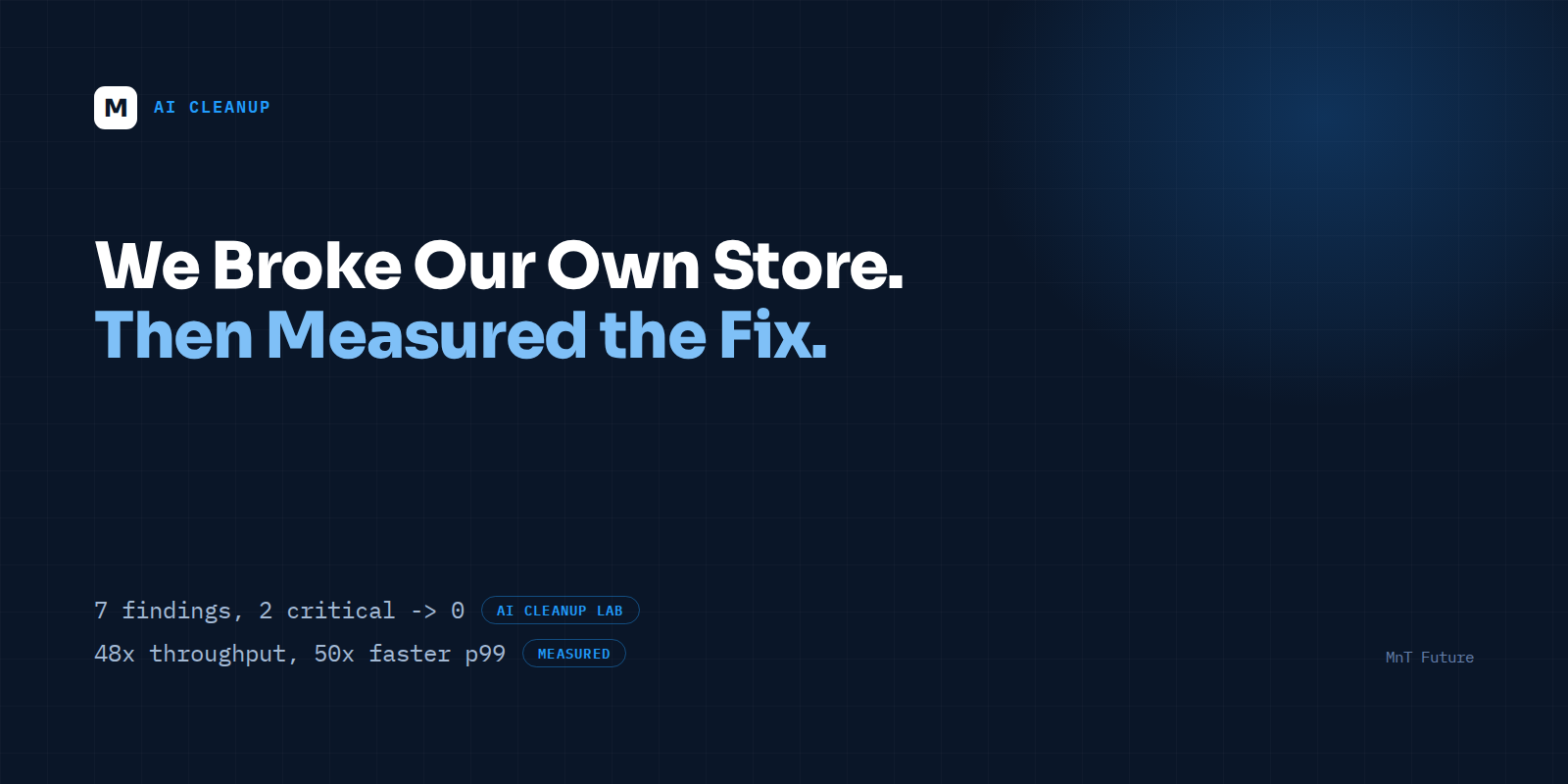
The audit surfaced 7 critical and high-severity security findings, including 2 classified critical. Five of those findings weren't theoretical: a live exploit prober confirmed 5 out of 5 exploitable paths into the application, meaning an attacker with no special access could have used them the day we found them.
None of this is a knock on AI coding tools themselves. It's what the research above predicts: models trained to produce functionally correct code are not the same as models trained to produce secure code, and nobody had put a human security review between the AI's output and production.
What fixing it actually took
A proper AI cleanup audit isn't a find-and-patch exercise — it's the same process behind every AI Cleanup engagement we run for clients. Each finding gets traced to its root cause in the code, not just the symptom, because AI-generated codebases tend to repeat the same insecure pattern in multiple places — patch one instance and the other three are still open.
After remediation:
- All 7 security findings closed. Both critical findings eliminated.
- All 5 confirmed live exploits closed — 5/5 down to 0/5.
- Every fix re-verified with the same static scanner, live exploit prober, and load test used to find the issues in the first place, so a fix that looked complete on paper had to prove it under the exact test that broke the store.
The surprise: performance moved too
We set out to fix security holes. The unplanned result was a performance rewrite. AI-generated code tends to over-fetch data, skip indexes, and run inefficient queries because the model optimizes for "it returns the right answer," not "it returns the right answer efficiently under load." Once we fixed the insecure patterns at their root, the inefficient patterns underneath them came out too.
The measured result: roughly 48x throughput improvement and roughly 50x reduction in p99 latency — the response time for the slowest 1% of requests, the ones that determine whether your site holds up during a traffic spike instead of timing out on real customers.
Why this matters more than a one-off fix
A store that demos well and a store that's production-ready are not the same claim, and the gap between them is exactly what an external audit is built to find. If your storefront was built primarily through AI tools or a no-code platform, the honest question isn't whether it has problems — the research says it very likely does. The question is whether you find them before a customer, an attacker, or a Black Friday traffic spike does.
What we'd tell you to check first
Start with three things: authentication and authorization logic (the most common source of critical findings in AI-generated code), whether your dependencies include any AI-hallucinated packages (a documented "slopsquatting" risk when a coding assistant invents a package name that an attacker later registers), and load behavior under 5-10x your normal traffic. Any one of those three can take a store down independently of the other two.
What does an AI cleanup audit for a vibe-coded store actually find and fix?
It typically finds authentication, injection, and access-control flaws — Veracode found 45% of AI-generated code samples introduce OWASP Top 10 vulnerabilities. A proper audit traces each finding to its root pattern, not just the symptom, closes any live exploit paths, and re-verifies every fix against the same tests that found the issue. Performance often improves sharply as a side effect, since the same inefficient patterns that create security gaps also create slow queries.
If your store was built fast with AI tools and has never been independently audited, that's worth 30 minutes before your next high-traffic event, not after it. Book a free AI Cleanup Lab review and we'll tell you honestly what we find — including if the answer is "you're in decent shape."