
Your AI-Built Store Is Installing Fake Packages
A founder ships a store in three weekends with an AI coding assistant. Checkout works, the theme looks sharp, payments clear in testing. Then comes the follow-up question nobody asks at launch: what did the AI actually pull into the codebase to make that happen, and who has looked at it since?
Most AI-cleanup conversations start with the visible failures — a page that crashes under load, an admin route with no auth check. Those matter. But two risks that never show up in a demo are quietly more common, and they live one layer down: the packages an AI coding tool installs without checking if they're real, and the credentials it hardcodes without telling anyone.
Your Coding Assistant Invents Packages — And Some Of Those Names Already Exist as Malware
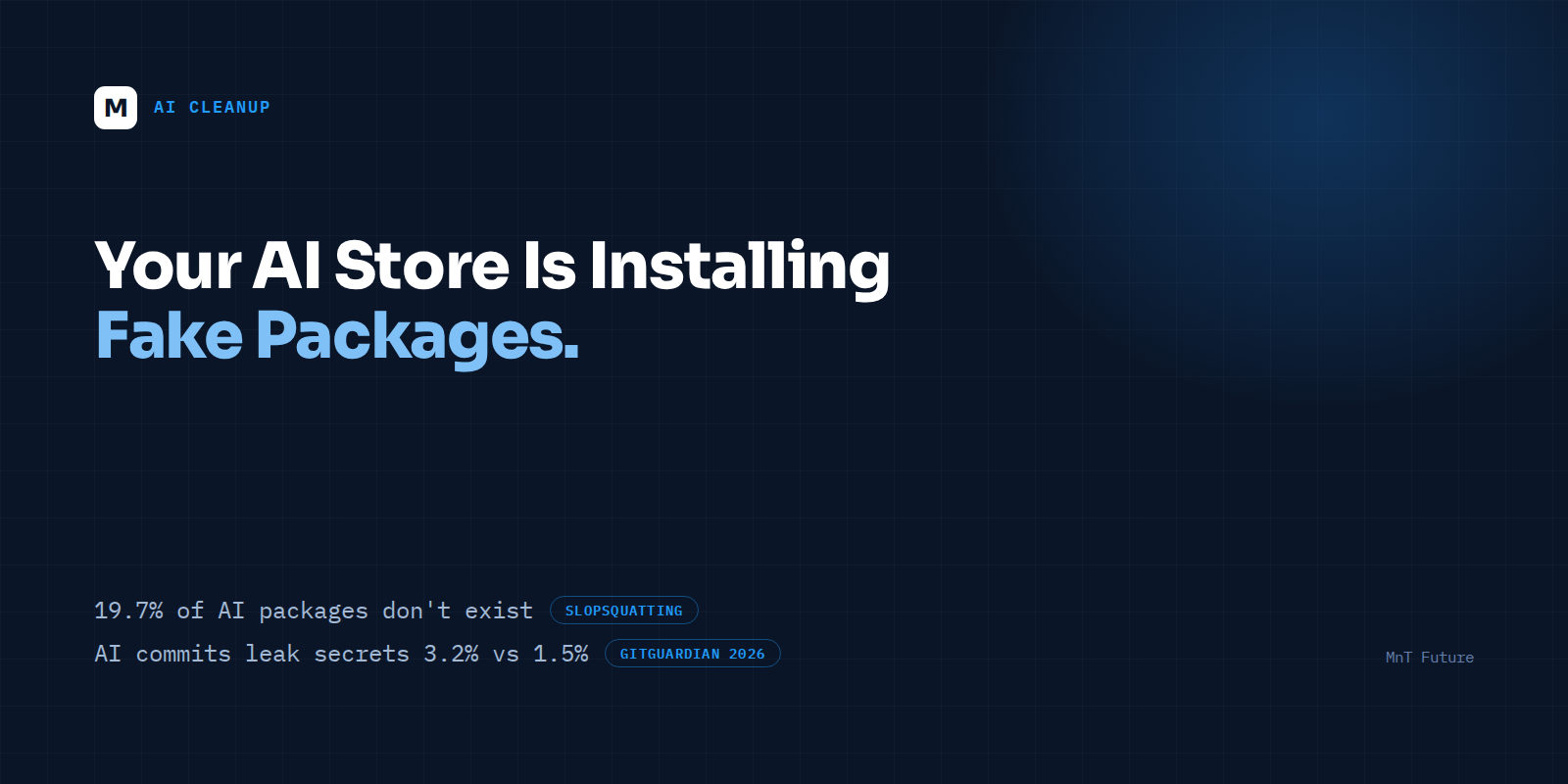
Large language models don't just write functions; they recommend dependencies. A 2025 academic study — "We Have a Package for You! A Comprehensive Analysis of Package Hallucinations by Code Generating LLMs" — tested code-generating models across 576,000 samples and found that roughly 19.7% of recommended packages didn't exist at all, more than 205,000 unique hallucinated names in total. Open-source models hallucinated more often, at 21.7% on average; even the more careful proprietary models did it 5.2% of the time.
Here's the part that turns a hallucination into an exploit path: 43% of those fake package names were recommended consistently across repeated queries. That predictability is what makes the attack — known as slopsquatting — practical. An attacker doesn't need to guess; they run the same prompts everyone else is running, see which fake names keep coming up, and register those names on the real package registry with working malware inside. The npm or PyPI install command runs exactly as the AI suggested it. Nothing looks wrong until it is. Security researcher Bar Lanyado proved the mechanism years earlier as a proof of concept — a hallucinated package called huggingface-cli, uploaded empty, pulled over 30,000 downloads in three months with no attack payload at all.
A store built fast with an AI assistant, and never audited afterward, has no record of which dependencies were verified against the real registry and which were installed because the model was confident-sounding rather than correct.
AI-Assisted Commits Leak Secrets at More Than Twice the Rate of Human Code
The second unaudited layer is credentials. GitGuardian's 2026 State of Secrets Sprawl research found 28.65 million new hardcoded secrets committed to public GitHub repositories in 2025 alone — a 34% year-over-year increase, the largest single-year jump on record. The AI-specific number is sharper: commits made with AI coding assistance leaked secrets at a rate of 3.2%, versus 1.5% for human-only commits — more than double. Leaked credentials tied to AI services specifically climbed 81% year-over-year to 1.27 million detected instances, including over 113,000 exposed API keys from a single provider found in public repos.
The reason is structural, not carelessness. An AI assistant asked to "connect to the payments API" will often write the key directly into the file to get something working immediately, the same way a developer might in a rushed prototype — except the assistant does it by default, at scale, across every file it touches, with no memory of which keys it already hardcoded three files ago. And once a secret ships, it tends to stay live: GitGuardian's data shows nearly 70% of credentials confirmed valid in 2022 were still valid through January 2025, and 64% remained unrevoked as of January 2026. A key baked into a vibe-coded storefront eighteen months ago is very likely still working today — for whoever finds it.
What an AI Cleanup Actually Checks
Neither risk shows up in a functional walkthrough, because both are invisible to the person clicking through the store. A real audit has to look under the app, not just at it:
- Dependency provenance. Every package in the lockfile checked against the real registry, install source, and maintainer history — not just "does npm install succeed."
- Secret scanning across full git history, not just the current branch, because a key removed from the latest commit is still sitting in an earlier one.
- Live credential rotation for anything that was ever exposed, on the assumption that exposure equals compromise until proven otherwise.
- Lockfile pinning and SCA (software composition analysis) tooling wired into the deploy pipeline, so a hallucinated or squatted package can't slip into a future build the same way it slipped into the first one.
- Load and penetration testing on top of the dependency and secrets work — the visible failures still need to be caught too.
This is the work MnT Future runs in its AI Cleanup engagements: take a store built fast with AI or no-code tools, find what's actually inside it — dependencies, secrets, access control, load behavior — fix what's broken, and harden what's fragile before it becomes an incident report instead of a blog post.
Does my AI-built ecommerce store have hidden dependency or credential risks?
Likely yes, if it's never been audited. AI coding tools hallucinate roughly 1 in 5 package names, some later registered as malware, and leak secrets in code at more than twice the rate of human-written commits. Only a dependency and secrets audit — not a functional test — confirms it.
The Fix Doesn't Require a Rebuild
None of this means the AI-built version of the store was a mistake. It means the layer nobody checks — what got installed, what got hardcoded — needs the same senior review any production system gets before it starts processing real customer payments. That's a hardening project, not a rewrite — the same before-and-after process documented in our own AI Cleanup Lab case study, and MnT Future prices it that way.
If you're not sure what's actually inside your store's dependency tree, a free agent-readiness audit is the fastest way to find out — it covers the security and compliance layer alongside how ready the store is for AI-agent traffic. Book a free strategy session and we'll walk through what we find.