
AI-Built Checkouts: The Price Bug Scanners Miss
Your AI-built store passed its security scan. The dependency checker is green, the SSL certificate is valid, and the last automated pen-test report is sitting in a folder labeled "passed." None of that tells you whether a customer can check out for one cent.
That is not a hypothetical. It is the single most common finding in stores built fast on Lovable, Bolt, Cursor, Replit and similar tools, and it rarely shows up in the kind of audit most founders run before launch — because the tools that catch SQL injection and exposed secrets are not built to catch a checkout that simply trusts the number the browser hands it.
Why Scanners Miss This
Automated security scanning is pattern matching. It looks for known-bad code shapes: an unescaped query string, a hardcoded API key, a missing authentication check. Those are real risks, and AI-generated code has plenty of them. But a checkout that accepts a price from a hidden form field, or a discount engine that never re-validates a coupon server-side, is not a bad code pattern. It is a business decision an AI coding assistant made without anyone in the room to say no.
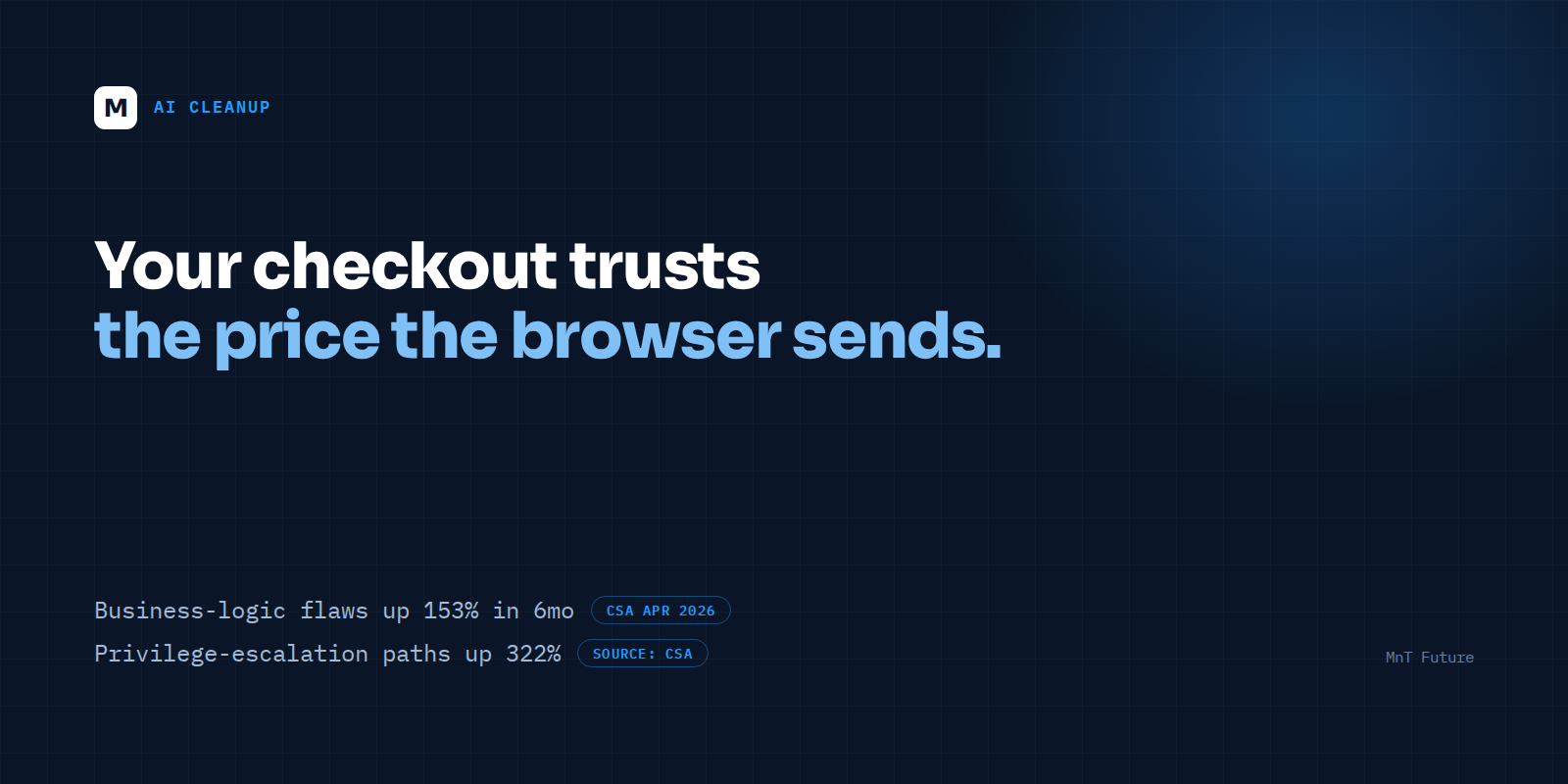
Cloud Security Alliance's April 2026 research note on AI-generated code puts a number on this shift. Over a six-month window, architectural and business-logic design flaws in AI-generated code rose 153%, and privilege-escalation paths rose 322% — both categories CSA describes as requiring "deep contextual reasoning to detect," which is exactly what a static scanner does not do. In the same period, monthly security findings in AI-assisted codebases went from roughly 1,000 to more than 10,000, and CVEs formally attributed to AI-generated code climbed from 6 in January 2026 to 35 in March — a number CSA believes is 5 to 10 times undercounted, because most of these flaws never get filed as a CVE at all. They get discovered by a customer, or a competitor, first.
What "Trusting the Client" Looks Like in Practice
In a checkout built this way, the failure usually shows up in one of three places. The price itself may be stored in a hidden form field or passed as a parameter the frontend sets, with nothing on the server re-checking it against the product catalog before charging the card. A discount code may be validated once in the browser and never re-verified at the moment of payment, which means a code that expired an hour ago — or one copied out of the site's own JavaScript bundle — still works. And cart logic built without transactional safeguards can let two overlapping requests apply the same one-time discount twice, or reserve the same unit of limited stock to two different buyers, because nothing locks the calculation while it runs.
None of these require a sophisticated attacker. They require someone who opens their browser's developer tools, which is a skill level far below "hacker" and well within "curious customer" or "competitor doing due diligence before a partnership call."
What is a client-side price manipulation vulnerability?
A client-side price manipulation vulnerability lets a shopper alter the price, discount, or quantity sent to a store's checkout — often through a hidden form field, exposed JavaScript, or an unlocked cart request — because the server accepts what the browser sends instead of recalculating it from the product database. The fix is server-side price authority: recompute every price and discount from the source of truth at the moment of payment, never at the moment of display.
Why This Is Now the Fastest-Growing AI-Code Risk
Injection bugs and exposed credentials get caught because they look wrong out of context — a security reviewer, human or automated, can spot a raw SQL string without knowing anything about the business. A checkout that trusts the client on price looks completely normal in isolation. It only looks wrong once someone understands that the price is supposed to be authoritative on the server, which is domain knowledge, not a code pattern. That is precisely the class of flaw CSA's data shows growing fastest, and it is also the class most founders assume their "security scan" already covers. It usually doesn't.
The Fix: Server-Side Price Authority
Closing this does not require a rebuild. It requires three specific changes, in order. First, every price, discount, and quantity gets recalculated from the database at the moment of checkout — never trusted from what the client submitted, no matter how it got there. Second, discount and inventory logic runs inside a transaction that locks the relevant rows, so two simultaneous requests can't both win a race that should only have one winner. Third, high-value calculations — the final charge amount, in particular — get a server-generated integrity check before the payment call fires, so a mismatch between what the customer saw and what the server is about to charge gets caught before money moves, not after.
This is the same discipline behind every engagement MnT Future runs under its AI Cleanup service: treat the store like an attacker would before a real customer, or a real attacker, does it for you. In MnT's own AI Cleanup Lab case study, that adversarial approach — building a deliberately flawed store, exploiting it, then rebuilding with hardened infrastructure — closed every live exploit it found, with every metric measured before and after rather than asserted.
What a Real Audit Actually Checks
A scan tells you whether known-bad patterns exist in the code. An audit tells you whether the business logic holds up when someone tries to break it on purpose — submitting a negative quantity, replaying an expired discount, firing two checkout requests at once, editing the price parameter directly. That difference is exactly where AI-built stores are failing right now, at a rate CSA's data says is accelerating, not leveling off.
If your store shipped fast on an AI coding tool and has never been tested this way, the honest first step is finding out where it stands before a customer — or a competitor — finds out for you.
Get a free agent-readiness audit from MnT Future, or book a free strategy session to walk through what a business-logic review of your checkout would actually look like.