
AI Traffic Is Surging. Your Conversion Rate Isn't.
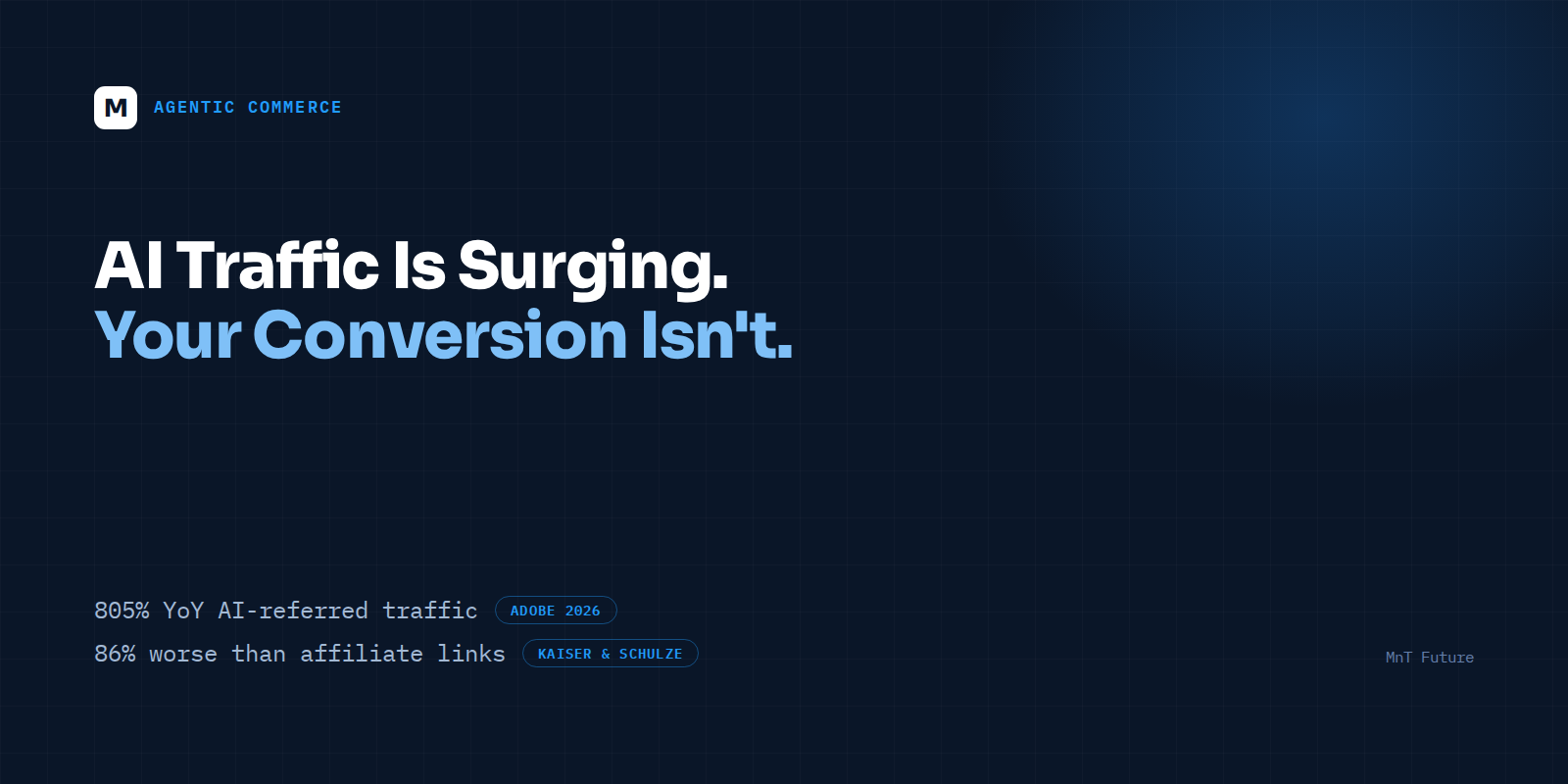
Sometime in the last year, a new referral source started showing up in your traffic reports: ChatGPT, Gemini, Perplexity, an AI shopping assistant you may not even recognize by name. The volume is real and it's growing fast — Adobe Analytics measured 805% year-over-year growth in AI-driven visits to US retail sites on Black Friday 2025 alone. If you run a D2C brand with any organic visibility, some share of that traffic is already landing on your product pages.
Here's the part that doesn't add up when you check the conversion column next to it: that traffic converts badly. According to a 2026 analysis by Kaiser and Schulze, cited in MetaRouter's Agentic Commerce Trends report, ChatGPT-referred sessions convert 86% worse than a standard affiliate link, and AI referrals as a whole still sit under 0.2% of total ecommerce traffic. The agents are showing up. They're mostly leaving without buying.
Quick answer: AI agent traffic is growing fast but converting poorly because most stores are built to be found by agents, not transacted with by them. Fixing it means exposing checkout, inventory, and payment capability through agentic commerce standards — ACP, Google UCP, and Retail MCP — so an agent can complete a purchase directly instead of just referring a visitor who has to start over on your site.
Why "Found" and "Bought" Are Now Two Different Problems
For most of the last decade, being discoverable to a shopper meant one thing: rank well, load fast, have clean product data. That still matters. But an AI agent doing product research on a user's behalf isn't behaving like a human clicking through a results page — it's evaluating your site as a potential transaction partner, and most storefronts were never built to answer that question. The agent can read your product page. It usually cannot check real-time inventory, apply a discount, or complete checkout without handing the user back to a browser tab — and that handoff is exactly where the 86% conversion gap comes from.
This is the distinction agent-readiness actually turns on: discoverability gets an agent to your site. Transactability is what lets the agent finish the job there. Right now, most US commerce sites have solved the first problem and ignored the second.
What Agent-Ready Checkout Actually Looks Like in 2026
Three standards are converging on this exact problem, and each is far enough along that ignoring them is now a competitive decision, not a wait-and-see one.
The Agentic Commerce Protocol (ACP), developed by OpenAI and Stripe, already powers Instant Checkout inside ChatGPT — a shopper can complete a purchase without leaving the chat interface, provided the merchant has integrated.
Google's Universal Commerce Protocol (UCP) launched as an open standard on January 11, 2026 with more than 20 partners at launch, including Shopify, Etsy, Walmart, and Target. At Google Marketing Live on May 20, 2026, Google expanded UCP's Universal Cart to let shoppers save products across retailers and check out via Google Pay or the retailer directly — with Nike, Sephora, Target, Walmart, Wayfair, and Shopify merchants Fenty and Steve Madden as initial partners. UCP works by publishing a JSON manifest at a standard address (/.well-known/ucp) that lets an agent discover a merchant's checkout, discount, and fulfillment capabilities automatically, without a custom integration for every agent that visits.
Retail MCP — a Model Context Protocol binding for commerce — gives agents a structured way to query product data and initiate transactions using the same protocol increasingly used to connect AI models to external tools and data sources generally.
None of these require an agent to guess at your site's structure. They require you to expose one.
Where Brands Actually Get Stuck
In practice, the gap between "agent finds us" and "agent can buy from us" comes down to three specific things: a product feed structured well enough for an agent to trust the data (price, availability, variants) without a human double-checking it; a checkout endpoint exposed through ACP or UCP's manifest standard rather than only through a browser-rendered cart flow; and payment handling that supports the tokenized, credential-based authorization these protocols use in place of a stored card number. Skipping any one of the three means an agent can describe your product accurately and still can't finish the sale — which is a plausible technical explanation for exactly the conversion gap Kaiser and Schulze measured.
The Cost of Waiting Is Competitive, Not Theoretical
Nike, Sephora, Target, Walmart, and Wayfair aren't experimenting with agent-ready checkout — they're already live inside Google's Universal Cart. That's not a signal that agent-readiness is coming eventually. For funded D2C brands, it's a signal that a meaningful share of category-defining competitors already treat this as solved, and every AI-referred visitor an unready brand loses to a browser handoff is a visitor an agent-ready competitor down the search results can close instead.
Where to Start
Agent-readiness isn't a rebuild. It's an audit of three things — your product feed's machine-readability, whether your checkout is exposed through ACP or UCP's manifest standard, and whether your payment stack supports tokenized agent authorization — followed by closing whatever gap the audit finds. That's a scoped engineering project, not a platform migration, whether you're running a custom or headless storefront build, and it's the kind of work that should be measured before it's built.
If you want to see exactly where your store stands against ACP, Google UCP, and Retail MCP before committing engineering time to it, MnT Future runs a free agent-readiness audit for US D2C and marketplace brands. It's the fastest way to find out whether your AI traffic problem is a discovery problem or the checkout problem the data suggests it actually is.