
DOJ Says Your ADA Settlement Isn’t Enough
A blind shopper can’t complete checkout on your site. A demand letter shows up two weeks later. Your lawyer gives the standard advice: settle quickly, pay the plaintiff, patch a handful of pages, and close the file before it turns into a class action. For years, that was the end of the story. As of this February, it isn’t anymore.
What Actually Happened in February 2026
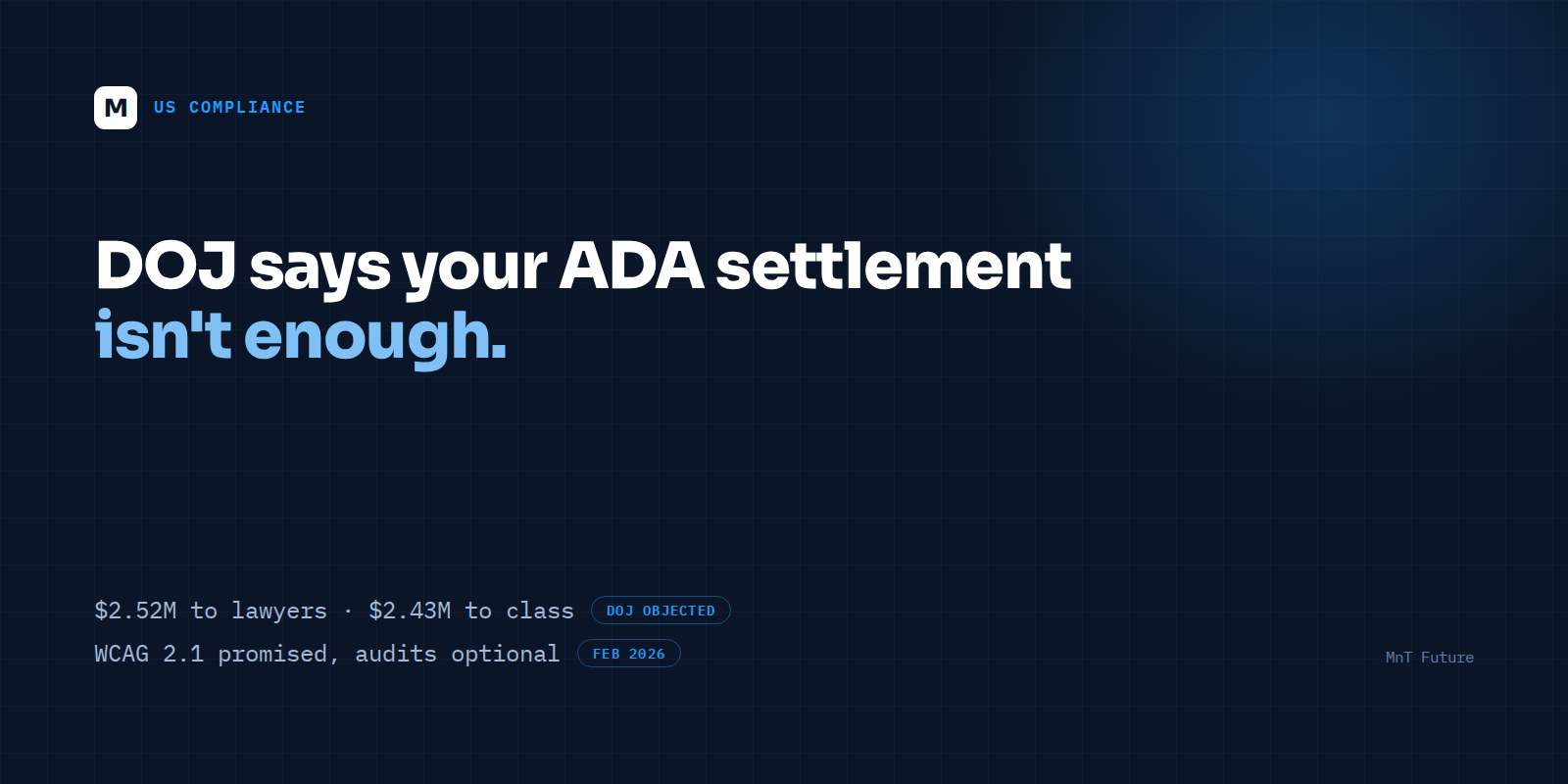
On February 2, 2026, the Department of Justice filed a Statement of Interest in Alcazar v. Fashion Nova, Inc., a case pending in the U.S. District Court for the Northern District of California. The underlying claim was familiar: a blind customer alleged Fashion Nova’s website was inaccessible under Title III of the ADA and California’s Unruh Act. The parties reached a settlement worth roughly $5 million — about $2.43 million in monetary relief to the California class (capped at $4,000 per household) and $2.52 million in attorneys’ fees, plus a promise to bring the site into “substantial conformance with WCAG 2.1.”
The DOJ objected. Its filing argued the settlement’s injunctive relief wasn’t meaningful, that the accessibility audits attached to it were optional rather than mandatory, and that class counsel’s fees nearly matched what the disabled shoppers actually harmed would receive. In its own words, the department does not oppose settlements that “actually make a website available” — it opposes using a civil claim “principally to enrich class counsel on the backs of persons with disabilities.” The court had a hearing on final approval February 12, and as of this writing the case remains pending.
Does settling an ADA website accessibility lawsuit close the case for good?
Not anymore. In February 2026, the DOJ formally objected to a proposed ADA website-accessibility settlement, arguing it enriched attorneys without meaningfully fixing the site. Courts and regulators increasingly expect verified, ongoing remediation — not a payout, a vague promise, and a press release.
Why This Changes the Math for Every US Brand
Most companies treat an ADA demand letter as a legal problem with a legal answer: negotiate a number, sign a release, move on. That calculation assumed the settlement itself was the finish line. The Fashion Nova objection shows a federal agency is now willing to look past the signature and ask whether the underlying site was actually fixed — and to say so publicly, in court filings, even after both sides have already agreed to terms.
Two details in the DOJ’s filing matter more than the headline. First, the settlement’s own commitment was to “substantial conformance” with WCAG 2.1 — a version already a full revision behind the current WCAG 2.2, which added success criteria that hit checkout and login flows directly (target size, dragging alternatives, accessible authentication). Second, the audits meant to verify that conformance were optional, not mandatory, which is exactly the gap DOJ flagged: a commitment nobody has to check is not a commitment.
Neither of those problems is unique to Fashion Nova. They’re the default shape of most quick ADA settlements — a dollar figure, a soft compliance promise, and no independent verification. That template is now a documented target for federal objection, not just a plaintiff’s talking point in the next lawsuit.
The Fix Nobody Wants to Hear
The uncomfortable part is that there’s no shortcut here that DOJ’s own filing hasn’t already named. An overlay widget bolted onto an inaccessible site doesn’t survive this kind of scrutiny, and neither does a settlement that promises “substantial conformance” without a mandatory, third-party-verifiable audit trail.
What does hold up: measurable remediation against a current standard (WCAG 2.2, not 2.1), fixed at the design-system level rather than page by page, verified with both automated tooling and manual testing, and documented well enough that a court — or a DOJ attorney reading the settlement two years later — can see exactly what changed and why. That’s the difference between a company that can show its work and one that’s hoping nobody checks. MnT Future built its own WCAG 2.x AA remediation this way: seven failing checks taken to zero across nine key pages through design-system fixes, with no overlay widget, verified with automated testing (axe-core) rather than a vendor’s compliance badge.
What to Do Before You’re Served
For a B2B or wholesale operator, or any established brand carrying real transaction volume, the order of operations should run the other direction from most companies’ current one:
Audit now, not after a demand letter arrives. An accessibility audit costs a fraction of a settlement and gives you a documented baseline if you’re ever sued.
Target WCAG 2.2, not 2.1. Courts and settlements are already treating 2.2 as the practical bar, even with no codified Title III regulation for private businesses.
Skip the overlay. Fix the design system — contrast, focus order, form labels, keyboard traps — once, at the component level, instead of patching individual pages.
Keep a paper trail. Automated scan results, manual test notes, and dated remediation records are what make a settlement (or a clean bill of health) defensible later.
Treat login-gated B2B portals the same way. A wholesale portal behind a login is still a place of public accommodation under Title III case law — “customers only” isn’t an accessibility exemption.
Accessibility risk doesn’t travel alone. It sits next to PCI DSS v4.0.1’s payment-page requirements and the multi-state sales-tax patchwork as the three compliance questions that decide whether a US commerce platform is actually production-ready — which is why MnT Future builds all three into commerce platform engagements rather than treating them as a legal team’s problem to solve after launch.
If your last ADA response was a settlement check and a promise, it’s worth finding out — before a plaintiff’s attorney or a DOJ filing does — whether the underlying site would actually hold up. MnT Future offers a free strategy session to walk through where your site stands against WCAG 2.2, PCI DSS v4.0.1, and your state sales-tax exposure, and what a real remediation path looks like if it doesn’t.