
ADA Overlay Widgets Won't Stop a Lawsuit in 2026
Your Legal Team Just Got a New Data Point, and It's Not Good
If your store runs an accessibility overlay widget — one of the drop-in scripts that promises instant ADA compliance for a few hundred dollars a month — you probably added it because someone told you it would keep you out of court. Q1 2026 says otherwise.
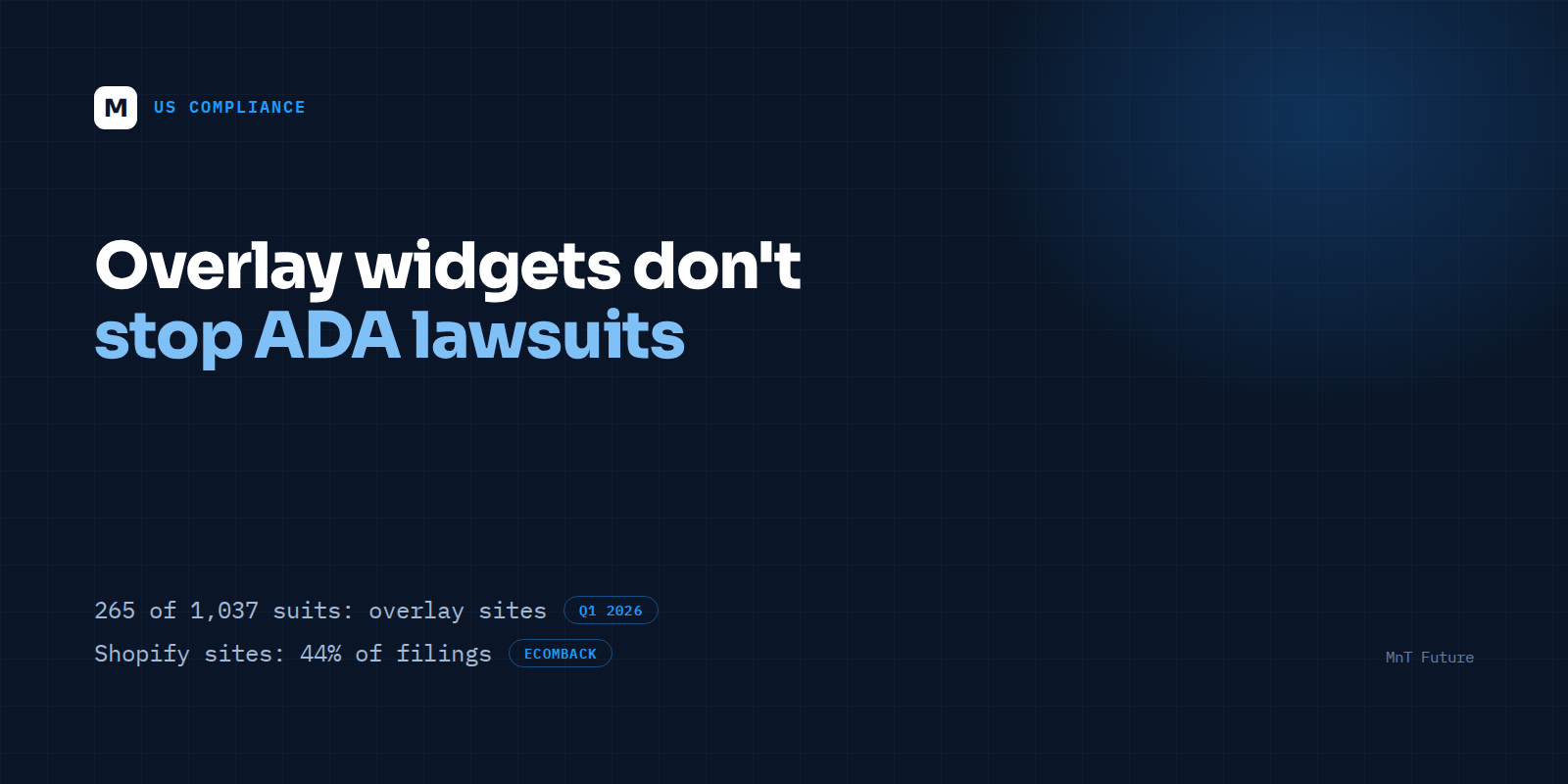
According to EcomBack's Q1 2026 ADA Website Lawsuits Recap Report, 1,037 ADA-related lawsuits were filed against US websites in the first three months of the year, a 5.49% increase over the 983 filed in the same period last year. Of those, 265 lawsuits — just over a quarter — named sites that already had an accessibility overlay widget installed. That's up from 209 widget-related cases in Q1 2025. The tool sold as a shield is showing up in more lawsuits, not fewer.
Why Overlay Widgets Keep Losing in Court
An overlay widget sits on top of your existing site and tries to patch accessibility problems at runtime — adjusting contrast, adding alt text guesses, intercepting keyboard focus — without touching the underlying markup. Screen reader users and disability advocates have been saying for years that this doesn't work reliably, and plaintiffs' firms have caught on. A widget can't fix a shopping cart that traps keyboard focus, a checkout form with no programmatic labels, or a product grid that a screen reader reads as a wall of unlabeled images. It can only cosmetically adjust what's already broken.
The lawsuits reflect that gap. A plaintiff's attorney testing your site with a screen reader or keyboard-only navigation will find the same broken checkout flow whether or not a widget is running. In a lot of cases, the presence of the widget becomes evidence that the brand knew accessibility was a live issue and chose a shortcut instead of a fix.
Who's Actually Getting Sued
The industry breakdown in the Q1 2026 data should get the attention of any brand running a commerce site with real transaction volume. Restaurant and food service businesses accounted for 334 lawsuits (32.21%), and fashion and apparel accounted for 261 (25.17%) — together, more than half of all filings. On the platform side, Shopify-built sites were named in 459 lawsuits, or 44.26% of the total, ahead of custom-coded sites at 31.24% and WordPress at 14.46%. That doesn't mean Shopify is inherently less accessible — it means Shopify's massive market share among D2C and wholesale brands makes it the platform plaintiffs' firms encounter most often, and a lot of Shopify themes and third-party apps ship with accessibility gaps nobody has audited.
Geographically, Illinois has overtaken New York as the top filing jurisdiction, with 256 suits (24.69%) in Q1 2026, followed by California (194) and Florida (186). And the litigation itself is concentrated: just 27 individual plaintiffs filed more than half of all Q1 2026 cases, and the top 10 law firms controlled 82.55% of filings. This isn't a diffuse risk spread across thousands of unrelated claims — it's a small number of highly active firms running a repeatable playbook against any site with obvious gaps.
What Actually Reduces the Risk
The fix that holds up is the unglamorous one: an audit against WCAG 2.2 AA criteria, remediation at the design-system and component level, and verification with an automated tool like axe-core plus manual keyboard and screen-reader testing. That means fixing color contrast in your actual CSS, adding real programmatic labels to form fields, making sure every interactive element is reachable and operable by keyboard, and testing checkout end to end with assistive technology — not layering a script on top and hoping it holds.
We ran this same audit on our own site before recommending it to anyone else — seven failing checks down to zero, verified with axe-core, without installing an overlay widget.
For a B2B or wholesale brand running a login-gated catalog, a quote request flow, or a multi-step checkout, the exposure compounds: more interactive components, more custom UI, more places for a keyboard trap or missing label to hide. That's also exactly the profile of brand where PCI DSS 4.0.1 compliance and multi-state sales tax nexus tracking are already live concerns, because all three — accessibility, payment security, and tax — are the compliance layer that a growing US commerce operation eventually has to get right, usually after outgrowing whatever was fast to launch with.
None of this is a reason to panic-remove your overlay widget today without a plan. It's a reason to get a real picture of where your site stands against WCAG 2.2 AA before a plaintiff's firm gets there first.
Do accessibility overlay widgets stop ADA lawsuits?
No. Q1 2026 data shows 265 of 1,037 ADA website lawsuits (25.55%) targeted sites that already had an overlay widget installed, up from 209 in Q1 2025. Overlays patch surface-level styling at runtime but don't fix underlying markup, so broken checkout flows and unlabeled forms remain. Real protection comes from a WCAG 2.2 AA audit and code-level remediation, verified with tools like axe-core.
Ready to know where your store actually stands? MnT Future offers a free strategy session to walk through your accessibility, PCI DSS 4.0.1, and sales tax posture before a lawsuit — or an audit — tells you the hard way.